

Understanding Beard Transplant Clinics: Your Path to Facial Hair Confidence
A beard transplant clinic specializes in relocating hair follicles from one part of your body (usually the back of your head) to areas of your face where you want more beard growth. These clinics offer permanent solutions for patchy beards, thin facial hair, or beard loss due to scarring.
What to know about beard transplant clinics:
- Success rate: Over 90% of patients achieve natural-looking, satisfactory results
- Procedure time: Typically 4-8 hours depending on graft count
- Recovery: Initial healing in 7-10 days, full results visible after 9-12 months
- Cost range: $5,000-$15,000 based on graft count and clinic location
- Techniques: FUE, FUT, DHI, and HST are common methods, with FUE being most popular
Beard transplants have surged in popularity as men increasingly recognize facial hair as a symbol of masculinity and style. Whether you’re dealing with patchy growth, thin areas, or complete inability to grow a beard, these specialized clinics can transform your appearance with permanent results.
The procedure is minimally invasive, performed under local anesthesia, and has evolved significantly in recent years with techniques that leave virtually no visible scarring. Most clinics now use ultra-refined follicular unit extraction (FUE) to harvest individual hair follicles, creating a natural-looking beard that grows just like normal facial hair.
I’m Dr. Matthew Casavant, and while my primary specialty is minimally invasive surgery, I’ve worked alongside beard transplant clinic specialists and witnessed how these procedures transform patients’ confidence and self-image. My experience with meticulous surgical techniques directly applies to the precision required in successful beard restoration procedures.
According to a comprehensive study published in the Journal of Cutaneous and Aesthetic Surgery, beard transplantation has become one of the most sought-after cosmetic procedures for men in the last decade, with satisfaction rates exceeding 90% in properly selected candidates.
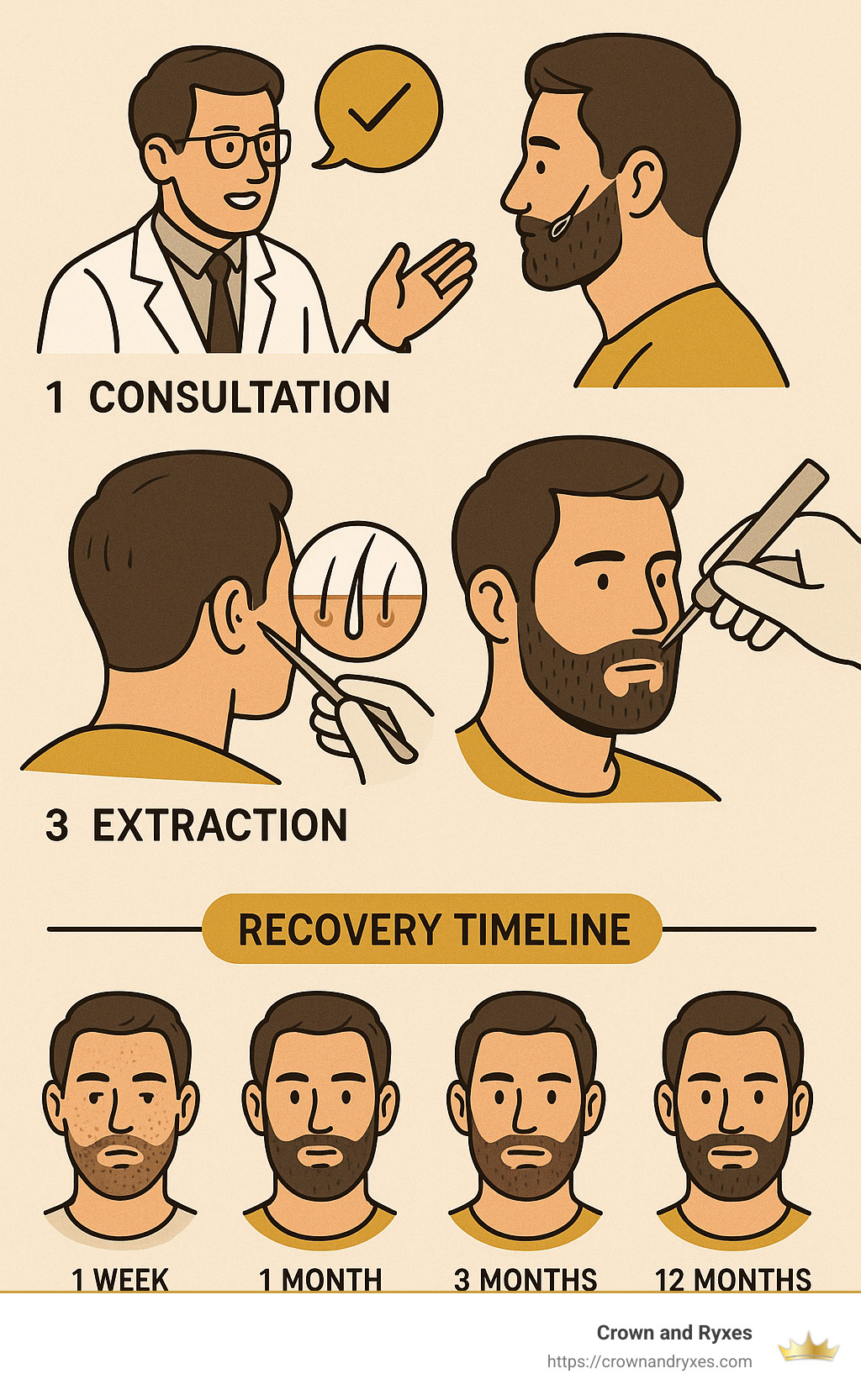
Beard transplant clinic terms to learn:
Are You a Candidate? Beard Transplant Fundamentals
“It is quite common to hear men say that they just can’t grow a beard, which typically means that it grows in patchy or won’t extend evenly across the lower face,” notes a leading facial plastic surgeon. This frustration leads many men to seek solutions at a beard transplant clinic.
You’re not alone if you’ve struggled with facial hair that refuses to cooperate. Beard transplants aren’t just for men who can’t grow any facial hair at all. You might be surprised to find you’re an excellent candidate if you deal with patchy growth, thin facial hair, scarring from injuries or burns, hair loss from medical conditions, or simply want more density for aesthetic reasons.
The magic behind beard transplantation is beautifully simple. Those stubborn hair follicles from the back of your head—the ones genetically resistant to balding—get a new home on your face. This donor area is specifically chosen to ensure your new beard will be with you for life, not just a temporary fix.
Here’s something worth celebrating: when using your own hair follicles, facial hair transplant procedures boast a remarkable success rate exceeding 95%. With numbers like that, it’s no wonder more men are embracing this life-changing solution.
According to WebMD’s comprehensive guide on beard transplants, the procedure has become increasingly mainstream with advancements in technology making results more natural than ever before. Their experts confirm that “the transplanted hair grows, falls out, and then regrows just like normal hair” after the initial healing phase.
What Is a Beard Transplant and How Does It Work?
A beard transplant uses your own tissue—what doctors call an autologous procedure. Think of it as relocating your hair’s home address from the back of your scalp to your face.
The journey begins with the harvesting phase, where hair follicles (grafts) are carefully extracted from your donor area. These follicles aren’t chosen randomly—they’re specifically selected because they’re programmed in your DNA to grow permanently.
Next comes the preparation phase, where each precious follicle is sorted, counted, and prepared under a microscope. This meticulous attention to detail ensures every graft remains viable for its new home.
Finally, during the implantation phase, your surgeon creates tiny recipient sites in your beard area. Each follicular unit is placed with artistic precision, considering the natural angle and direction of beard growth. This careful placement is what separates good results from great ones.
One satisfied patient who visited a beard transplant clinic in Los Angeles shared: “I was totally blown away by the level of customer service and professionalism from the staff and providers. The results look completely natural—nobody can tell I’ve had anything done.”
While your new beard hairs will grow like natural facial hair, they’ll retain some characteristics of their original home. This means they might grow more quickly than typical beard hair, potentially requiring more frequent trimming—a small price to pay for a full, confident look.
Who Makes a Good Candidate?
Not everyone is an ideal candidate for this transformative procedure. The path to beard success depends on several important factors.
You’ll need sufficient donor hair in the back of your scalp. Without enough density there, surgeons can’t harvest the required grafts without creating noticeable thinning. Your overall health matters too—you should be free from conditions that might impair healing or increase surgical risks.
Realistic expectations are absolutely crucial. Understanding that full results take time (typically 9-12 months) and recognizing the procedure’s limitations will help ensure your satisfaction. Most beard transplant clinics require patients to be at least 20 years old, as facial hair patterns may still be developing in younger men.
Your face should also be free from active skin conditions like infections, severe acne, or inflammatory issues that could interfere with the procedure or healing process.
During your consultation at a beard transplant clinic, a specialist will thoroughly evaluate these factors to determine if you’re ready for this journey. As one clinic notes, “Any person who is genetically incapable of growing a beard or who has lost his beard for other reasons, who are at least 20 years old, and who has no health issues that would preclude the FUE Method from being used during the process, is a candidate for a beard transplant.”
The science supports the effectiveness of this approach. Scientific research on beard transplant success rates consistently shows that with proper candidate selection and technique, the vast majority of patients achieve natural-looking, permanent results. For more specific information about the procedure, you can explore Beard Implants options that might be right for your unique situation.
Techniques & Customization for Natural‑Looking Results
Walking into a beard transplant clinic for the first time, you might wonder how they’ll transform your patchy facial hair into the full, robust beard you’ve always wanted. The secret lies in both the technical approach and the artistic customization—two elements that work hand-in-hand to create results that look completely natural.
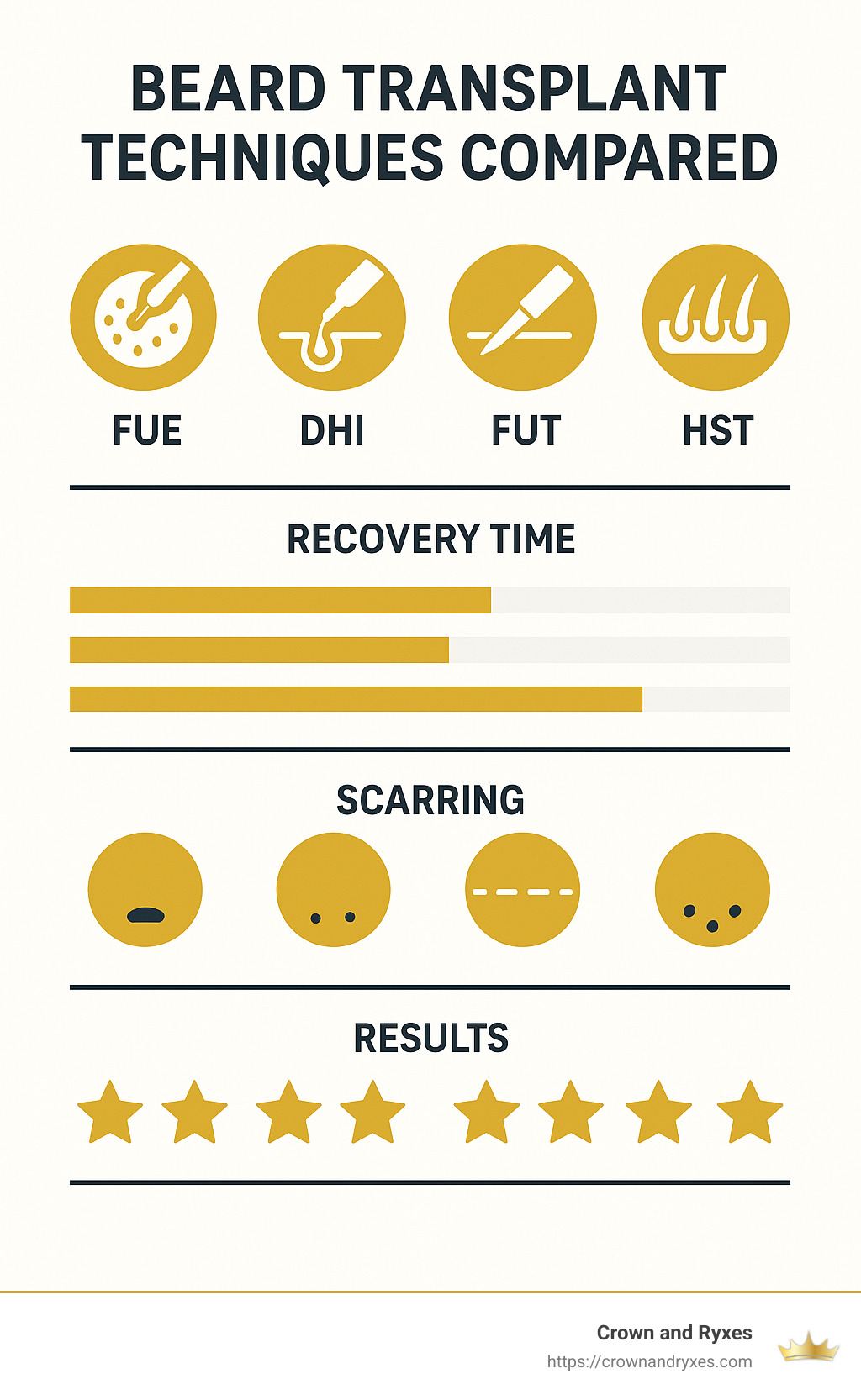
Comparing FUE, DHI, FUT & HST
The technique your surgeon uses makes all the difference in your comfort, recovery, and final results. Let’s break down your options in terms you can actually understand:
When Jake came to our clinic with a patchy goatee, we recommended Follicular Unit Extraction (FUE)—currently the most popular choice among our clients. “I was worried about scarring,” Jake told us after his procedure, “but there’s literally nothing visible unless you’re inspecting my scalp with a magnifying glass.” That’s because FUE uses tiny micro-punches (less than 1mm in diameter) to harvest individual hair follicles, leaving only microscopic dots that fade into invisibility. You’ll experience minimal discomfort, faster recovery, and best of all—you can rock any hairstyle without worrying about visible scars.
For clients seeking ultra-precise results, Direct Hair Implantation (DHI) offers some compelling advantages. This advanced variation of FUE uses a specialized implantation tool that gives your surgeon remarkable control over the depth, angle, and direction of each hair follicle. One of our patients, Marcos, chose DHI for his mustache improvement and was thrilled with how the technique allowed for denser placement with less trauma to his skin. “The recovery was so smooth, I almost forgot I’d had a procedure,” he shared at his follow-up appointment.
Some clinics still offer Follicular Unit Transplantation (FUT), an older technique that removes a strip of scalp from the donor area. While this allows for harvesting more grafts in a single session, it leaves a linear scar at the back of your head. We generally don’t recommend this for beard transplants—why deal with visible scarring when better options exist?
For those looking at cutting-edge approaches, Hair Stem-cell Transplantation (HST) represents the future of hair restoration. Rather than relocating entire follicles, HST uses only the stem-cell portion of hair follicles, stimulating multiple new hairs from each extraction. This means extremely high density with minimal impact on your donor area. The results last a lifetime, and there’s virtually no visible scarring. It’s truly remarkable technology that’s changing the game for beard restoration.
We’re also seeing innovations like NeoGraft (an automated FUE system) and Ultra-Refined FUT (URFUT) that aim to improve efficiency and reduce recovery time. Your consultation at our beard transplant clinic will help determine which approach best suits your specific needs.
Designing Your Dream Beard
Here’s where science meets art. The planning stage is absolutely crucial—it’s what transforms a good beard transplant into a great one that has people wondering if you were just blessed with amazing genes.
When Michael visited our beard transplant clinic hoping to fill in his patchy cheeks, our surgeon spent nearly an hour on beard line art alone. “He actually discouraged the perfectly symmetrical lines I initially wanted,” Michael explained later. “He showed me how slight asymmetry would look more natural—and he was absolutely right.”
Your surgeon will carefully mark your face with a specialized marker, planning a natural-looking hairline that complements your unique facial structure. Instead of harsh, straight lines (which scream “transplant”), we create soft zigzag patterns that mimic natural growth. Your facial bone structure helps determine the ideal beard line height and contours.
The density planning is equally important. We strategically place single-hair grafts along your beard borders, creating a soft, gradual transition rather than an abrupt edge. This subtle technique is something you’ll notice in all our before-and-after photos—there’s never that “doll hair” look that can happen with less experienced clinics. Meanwhile, we place multiple-hair follicular units in the central beard areas for maximum density where you want it most.
The angle and direction of each implanted follicle must perfectly match the natural downward growth pattern of facial hair. These angles vary slightly across different facial regions—downward on the cheeks, more angled on the jawline, and nearly horizontal under the chin. Getting this right requires both technical precision and an artistic eye.
For clients with specific ethnic backgrounds, we tailor our approach to match your natural hair characteristics. African American clients often benefit from specialized curved-needle techniques that accommodate curly hair follicles, while Asian clients might need particular attention to angle placement due to typically straighter hair shafts.
At Crown and Ryxes, we recognize that your dream beard is uniquely yours. Whether you’re seeking a full Viking-style beard, a precisely defined goatee, a distinguished mustache, or simply improved sideburns, we create a personalized plan that considers your facial structure, skin tone, hair texture, and personal style preferences.
During your consultation, we’ll discuss everything from the beard style that best complements your face shape to the optimal density for a natural appearance. We might even recommend a style you hadn’t considered—one that would particularly flatter your features. After all, your beard should look like it’s always been there, just the way nature intended.
Want to explore your options? Learn more about our FUE Hair Implant technique and how we customize it for facial hair restoration. Your perfect beard is waiting—and it starts with the right technique in the hands of skilled professionals who understand both the science and the art of beard design.
Stepyy: From Consultation to Recovery
The journey at a beard transplant clinic is a lot like preparing for a big trip – you need to know what to pack, what to expect, and how to make the most of your experience. Let’s walk through your beard change journey together, from the moment you schedule your consultation to the day you stroke your full, natural beard with pride.
Day of Surgery: What to Expect
When your procedure day at Crown and Ryxes finally arrives, you might feel a mix of excitement and nerves – that’s completely normal! We’ve designed our process to keep you comfortable while delivering exceptional results.
Unlike many surgical procedures, you can actually enjoy a light breakfast before arriving. When you walk through our doors, we’ll start by taking some “before” photos (don’t worry, these won’t end up on social media – they’re just to document your amazing change). Then comes the fun part – finalizing your beard design with your input. This is your face, after all!
We’ll make sure you’re comfortable with medication if needed before applying local anesthesia to both your donor and recipient areas. Some of our patients prefer our “Deep Sleep Method” with sedation for extra comfort.
As James, one of our recent patients put it: “I was worried about pain, but thanks to the anesthesia, I barely felt a thing. Any discomfort afterward was really mild and easily handled with the medication they gave me.”
The donor hair extraction typically takes 1-3 hours depending on how many grafts you need. You’ll be positioned comfortably, usually lying face down, and our team will ensure you get breaks whenever needed. After extraction, we’ll give you a proper lunch break to stretch, use the restroom, and refuel before the main event.
The creation of recipient sites and careful placement of each graft is the longest part of your day, usually lasting 2-5 hours. We take our time to ensure each tiny hair is placed at just the right angle and depth for natural-looking results. Don’t worry about boredom – we offer movies, music, and conversation to help the time pass pleasantly.
Recovery & Aftercare Essentials
The care you provide in the days and weeks after your procedure is just as important as the procedure itself. At Crown and Ryxes, we don’t just send you home with a sheet of instructions – we partner with you throughout your recovery journey.
Those first 48 hours are crucial. You’ll notice some swelling and redness, which typically peaks around day three. Sleep with your head lifted to keep swelling down, and resist the urge to touch, rub, or scratch your newly transplanted hair. Apply the antibiotic ointment we provide exactly as directed, and take any prescribed medications on schedule.
During your first week, you’ll follow a gentle cleaning routine using special solutions we provide. Your lifestyle will need some temporary adjustments too – no direct sunlight, swimming, saunas or steam rooms. Your favorite spicy foods, alcohol and caffeine will need to wait, and you’ll want to avoid activities that make you sweat heavily.
By weeks 2-4, you’ll see tiny crusts around the follicles naturally falling away. Don’t panic when the initial transplanted hairs shed – this is completely normal and just means your follicles are preparing for new growth. You’ll gradually return to normal activities, but no shaving the transplanted area for at least 2-4 weeks, and keep protecting it from direct sun.
Mark from Manchester told us: “The team at Crown and Ryxes didn’t just perform my procedure and disappear. They checked in regularly, answered every question (even the silly ones), and made me feel supported throughout my recovery.”
Many patients also benefit from our PRP (Platelet-Rich Plasma) therapy, where we use growth factors from your own blood to improve healing and stimulate growth. It’s like giving your new beard a super-charged nutritional boost!
When Will I See Full Results?
The path to your perfect beard is a marathon, not a sprint. Understanding the timeline helps manage expectations and celebrate each milestone along the way.
During the first 1-2 weeks, you’ll move through the initial healing phase. The scabs and crusts will fall off, redness and swelling will calm down, and you’ll see those transplanted hairs proudly on display.
Then comes the 2-4 week mark – the shedding phase. This is when many patients call us in a panic! Most of those transplanted hairs will fall out, but don’t worry – this “shock loss” is completely normal. The follicles remain safely in place, just taking a short nap before the real growth begins.
Around months 3-4, you’ll spot the first exciting signs of new growth. These initial hairs might be finer and sparser than you’d like, but they’re just the scouts for the full army of facial hair to come.
By months 6-9, you’ll notice a significant improvement. About 60-70% of your final results will be visible, with steadily increasing density and normalizing texture. This is when many of our patients start receiving compliments and questions about their beard care routine.
The grand finale comes at 9-12 months, when you’ll see your full results in all their glory. Your transplanted hairs will have matured in texture and thickness, establishing a natural growth pattern that’s indistinguishable from naturally-grown facial hair.
At Crown and Ryxes, we stay with you every step of the way, with follow-up appointments scheduled at key milestones: one day after your procedure, one week, one month, and then at 3, 6, and 12 months. We’re as invested in your results as you are!
As Dr. Roberts from our beard transplant clinic often tells patients: “The best things in life are worth waiting for, and your perfect beard is no exception. The patience you show during recovery will be rewarded with results that last a lifetime.”
Cost, Risks & Long‑Term Benefits
Let’s talk money, risks, and rewards – the practical side of your beard change journey. At Crown and Ryxes, we believe in complete transparency about what you’re investing in, what to expect, and the lasting benefits you’ll enjoy.
Most beard transplants cost between $5,000 and $15,000 total, though prices vary widely based on your specific needs and the clinic you choose. This investment delivers permanent results that continue paying dividends in confidence and appearance for decades to come.
Understanding Pricing Factors
When you’re researching costs at a beard transplant clinic, you’ll notice significant price variations. Here’s why:
The number of grafts required is the primary cost driver. A small mustache improvement might need just 350-500 grafts, while a patchy goatee typically requires 600-1,200 grafts. For a full beard change, you’re looking at 2,000-3,000+ grafts. Since clinics charge roughly $3-$7 per graft, this significantly impacts your total investment.
Geographic location plays a major role too. A procedure in Beverly Hills or Manhattan will typically cost more than the same procedure in smaller cities. Medical tourism destinations like Turkey offer substantially lower prices, but you’ll need to factor in travel expenses and potential communication challenges.
One patient shared his experience: “I paid $2,800 for what was supposed to be 3,500 grafts in Istanbul, including my hotel and airport transfers. When they needed to use more grafts – 4,250 total – they charged just $100 per additional 500 grafts. The value was incredible compared to US quotes I received.”
The surgeon’s expertise and clinic reputation significantly impact pricing. Board-certified surgeons with specialized training in facial hair restoration command premium rates – and for good reason. Their experience translates directly to better results and fewer complications.
Advanced techniques like DHI (Direct Hair Implantation) or HST (Hair Stem-cell Transplantation) typically cost more than standard FUE, but may offer advantages worth considering. Additional services like PRP therapy (typically $300-$800 extra) can improve results but add to your total investment.
At Crown and Ryxes, we offer financing options to make your beard change more accessible, with transparent all-inclusive packages that prevent surprise costs down the road.
Possible Risks & How to Minimize Them
While beard transplants boast an impressive safety profile, understanding potential risks helps you make informed decisions and take appropriate precautions.
Infection is rare but possible after any surgical procedure. Following aftercare instructions and taking prescribed antibiotics dramatically reduces this already small risk. If you notice unusual warmth, increasing redness, or discharge, contact your clinic promptly.
Folliculitis – inflammation of hair follicles – sometimes occurs as new hairs emerge. This temporary condition typically responds well to topical treatments. Gentle cleansing and avoiding irritation during recovery helps prevent this issue.
Scarring concerns many patients, but modern FUE techniques have revolutionized outcomes. The donor area typically heals with tiny, nearly invisible dots rather than the linear scars of older techniques. Choosing an experienced surgeon at a reputable beard transplant clinic and following wound care instructions carefully minimizes visible scarring.
Temporary numbness in treated areas is normal and typically resolves within weeks to months as nerve endings heal. This isn’t considered a complication but rather an expected part of the healing process.
Some patients worry about unnatural appearance, but this risk primarily exists with inexperienced providers. A skilled surgeon carefully plans each hair’s placement angle and direction to mimic natural growth patterns. Reviewing before-and-after photos of a clinic’s previous beard transplant patients gives you the best indication of their aesthetic capabilities.
A small percentage of transplanted follicles may not survive – this is normal and accounted for in your treatment plan. Following aftercare instructions carefully maximizes graft survival rates.
“I was worried about risks going in,” shared one patient, “but my surgeon walked me through everything so thoroughly that I felt completely comfortable. Six months later, my results look completely natural – even my barber couldn’t tell I’d had anything done.”
FAQs: Beard Transplant Quick Answers
Is a beard transplant painful? Most patients experience minimal discomfort during the procedure thanks to effective local anesthesia. Post-operative discomfort is typically mild and easily managed with over-the-counter pain medication. As one patient described: “The pain during surgery was minimal (2/10), but sitting in the same position for hours was the real challenge (7/10).”
Are beard transplant results permanent? Yes! The transplanted hair follicles from the back of your scalp are genetically resistant to balding, making your results lifelong. These hairs maintain their original characteristics, growing indefinitely just like your natural beard hair would.
Will there be visible scarring? With modern FUE techniques, scarring is minimal. The donor area will have tiny dot-like scars that become virtually invisible once hair grows back around them. The recipient area generally shows no visible scarring once healed, allowing you to confidently wear any beard style – or even go clean-shaven if you choose.
How much downtime should I expect? Most patients return to light activities within 1-2 days and work within 3-5 days. The social downtime – when your face looks presentable in public without obvious signs of the procedure – is typically 7-10 days as scabs naturally fall off.
What if I don’t have enough donor hair on my scalp? Don’t worry – alternatives exist! For patients with limited scalp donor hair, surgeons can sometimes use body hair from the chest or back. In other cases, beard-to-beard transplantation redistributes existing facial hair to create more balanced coverage. Your consultation will determine the best approach for your situation.
Will the transplanted beard hair grow like normal beard hair? Transplanted hairs retain characteristics of their origin (usually scalp hair). This means they may grow faster than natural beard hair and might have a slightly different texture. Most patients find they need to trim their transplanted beard hair more frequently, but the aesthetic result is still naturally masculine and attractive.
Can I shave after a beard transplant? You’ll need to hold off on shaving the transplanted area for at least 2-4 weeks to allow proper healing. After this initial recovery period, you can shave carefully. As your beard transplant clinic will advise: “Wait until all scabs have naturally fallen off (typically 3-4 weeks) before introducing any razor to the area.”
For more detailed information about costs and what to expect, visit our dedicated pages on Beard Transplant Cost and Beard Transplant Cost Per Graft.
How to Choose the Right Beard Transplant Clinic
Choosing the right beard transplant clinic might be the single most important decision you’ll make on your journey to facial hair confidence. This choice will shape not just your results, but your entire experience from consultation through recovery.
I’ve seen how this decision can make all the difference. At Crown and Ryxes, we encourage everyone considering this life-changing procedure to become informed consumers first. Let me walk you through what really matters when making this choice.
Board certification matters more than you might think. Look for surgeons who are board-certified in relevant specialties like dermatology or plastic surgery. Membership in the International Society of Hair Restoration Surgery (ISHRS) is another good sign that your provider takes their craft seriously. This isn’t just about credentials on a wall—it’s about ensuring your face is in the hands of someone with verified expertise.
The difference between a good and great result often comes down to experience specifically with facial hair transplantation. During consultations, don’t be shy about asking how many beard procedures the surgeon performs monthly or yearly. Beard work requires different skills than scalp transplantation—the angles, density planning, and artistic considerations are unique.
One patient told me: “I researched several clinics and was shocked at how different their approaches were. The surgeon I eventually chose spent nearly an hour discussing how beard hair grows at different angles across the face. That attention to detail sold me.”
Technology and techniques vary widely between clinics. The most advanced beard transplant clinics offer multiple options like FUE, DHI, and other specialized methods. Ask about the specific tools they use—quality clinics invest in high-powered magnification equipment and precision instruments that improve graft survival rates.
Questions to Ask a Beard Transplant Clinic
The consultation is your opportunity to gather crucial information. Don’t waste it! Here are the questions that reveal the most about a beard transplant clinic:
About the surgeon, ask: “What percentage of your practice is dedicated to beard transplantation?” This reveals whether facial hair is a specialty or just an occasional procedure they offer.
Regarding the procedure itself, find out: “Who performs each part of my transplant?” Some clinics have the surgeon design the hairline but technicians handle the actual extraction and placement. At Crown and Ryxes, our surgeons remain actively involved throughout the entire procedure.
For results and recovery, ask: “What is your average graft survival rate?” Good clinics track this data and should be transparent about it. Also important: “What happens if I need additional grafts after healing?” Their answer reveals their confidence and commitment to your satisfaction.
When discussing costs, always ask: “What exactly is included in this price?” Some clinics advertise low base rates but charge extra for essentials like post-operative medications or follow-up appointments.
A thoughtful patient shared with me: “The most revealing question I asked was simply, ‘Why shouldn’t I choose your clinic?’ The honest answer I received—acknowledging their strengths but also where other clinics might excel—showed integrity that made me trust them completely.”
Red Flags When Assessing a Beard Transplant Clinic
Your facial appearance is too important to risk with the wrong provider. Watch for these warning signs when evaluating a beard transplant clinic:
Suspiciously low prices should immediately raise questions. Quality beard transplantation requires significant time and expertise—clinics charging far below market rates are likely cutting corners somewhere, whether in sterilization protocols, graft handling, or by using inexperienced technicians.
Be wary if a clinic shows reluctance to share before/after photos of their actual patients. Reputable clinics document their work extensively and proudly display real results. If they only show a few “best cases” or use generic stock photos, that’s a serious concern.
Overpromising results is another major red flag. Ethical clinics set realistic expectations about density, growth timeline, and potential limitations. Anyone guaranteeing “100% success rates” or “perfect results” isn’t being honest with you.
Watch out for high-pressure sales tactics like “today only” discounts or urgent deadlines to book. Quality clinics understand this is a significant decision that shouldn’t be rushed. Your consultation should feel educational, not like a sales pitch.
A vague aftercare plan suggests potential problems ahead. Top clinics provide detailed written instructions, scheduled follow-ups, and clear access to support during recovery. This ongoing care is crucial for optimal results.
One patient warned: “I almost went with a clinic that seemed perfect until I realized they wouldn’t clearly explain who would be performing each part of my procedure. When pressed, I found the ‘lead surgeon’ only designed the hairline while technicians with minimal training did everything else. I’m incredibly glad I kept researching.”
At Crown and Ryxes, we believe in complete transparency throughout your journey. Our surgeons remain directly involved in every procedure, we provide comprehensive aftercare support, and we never pressure patients into hasty decisions. We understand that choosing the right beard transplant clinic is about finding a partner for your change, not just a provider for a procedure.
Hair Transplant Clinic: How to Choose the Right One for Your Needs
Conclusion & Free Consultation
The journey to a fuller beard is truly transformative—far beyond the physical change itself. Throughout this guide, we’ve walked through every aspect of beard transplantation, from understanding if you’re a good candidate to recognizing what makes a beard transplant clinic worth your trust. Now, it’s time to bring it all together.
Think about what brought you here in the first place. Maybe it’s those patchy spots that never quite filled in despite your best efforts. Perhaps it’s scarring that’s interrupted your natural growth. Or maybe you’ve simply never been able to grow the beard you’ve envisioned for yourself.
At Crown and Ryxes, we see these stories every day. We understand that facial hair isn’t just about appearance—it’s about how you see yourself when you look in the mirror. That’s why we’ve built our approach around not just technical excellence, but true artistry that honors your individual features and goals.
When men visit our Florida clinics, they often tell us they wish they’d made the decision sooner. As one patient recently shared: “For years I struggled with patchy facial hair that made me feel less masculine. Now, I have the full beard I’ve always wanted, and nobody can tell it’s been transplanted. It’s truly transformed my confidence.”
What makes our approach different? We believe it comes down to three essential elements:
Personalized design that complements your unique facial structure and personal style. No cookie-cutter approaches here—we carefully plan every hairline, angle, and density pattern to create results that look like you were simply blessed with great beard genetics.
Technical precision through our specialists’ mastery of advanced techniques like FUE, DHI, and HST. This expertise allows us to select the perfect approach for your specific situation, maximizing both aesthetic outcomes and your comfort throughout the process.
Comprehensive support from your first consultation through your final follow-up. We’re with you at every step, providing clear guidance, answering questions, and ensuring you have everything needed for optimal healing and growth.
The beard transplant journey requires patience—those full, impressive results develop over 9-12 months as transplanted follicles establish themselves and mature. But our patients consistently tell us the wait is more than worthwhile.
Ready to explore what’s possible for your beard? We invite you to schedule a free, no-obligation consultation at our Clermont or Lady Lake locations. During this relaxed conversation, we’ll:
- Evaluate your donor hair potential and facial structure
- Discuss your ideal beard style and density goals
- Explain which techniques would work best for your situation
- Provide a clear, transparent cost estimate
- Answer all your questions—with zero pressure to proceed
Your perfect beard might be just one conversation away. Reach out to our friendly team today, and let’s discuss how we can help you achieve the natural, confidence-boosting results you deserve.