Why Finding the Best Hair Transplant Surgeon Matters More Than You Think
The best hair transplant surgeon isn’t just about credentials—it’s about finding an expert who combines technical skill, artistic vision, and a personalized approach. With many doctors performing hair transplants, choosing the right one can feel overwhelming.
Key factors that define the best hair transplant surgeons:
- Experience Level: 10-30+ years of practice with thousands of procedures performed.
- Board Certifications: Credentials from organizations like ISHRS (International Society of Hair Restoration Surgery) or ABHRS (American Board of Hair Restoration Surgery).
- Patient Reviews: Average ratings of 4.5/5 or higher with consistent positive feedback.
- Procedure Volume: Quality-focused surgeons typically perform only 1-2 transplants per day.
- Artistic Skill: Natural hairline design that complements your face.
- Technical Expertise: Proficiency in both FUE and FUT methods.
The research is clear: top hair restoration doctors perform between 5,000 to 20,000+ transplants over their careers, demonstrating that extensive experience directly correlates with better outcomes.
What you need to know about costs: The average hair transplant in the USA costs between $8,000 and $26,250, with an average of $5.44 per graft. For a typical 2,500 graft procedure, expect to pay around $13,610.
Choosing the best hair transplant surgeon requires looking beyond marketing claims to find someone who truly prioritizes your results. Experience in advanced, minimally invasive procedures has shown that the right surgeon makes all the difference in achieving natural, lasting outcomes.
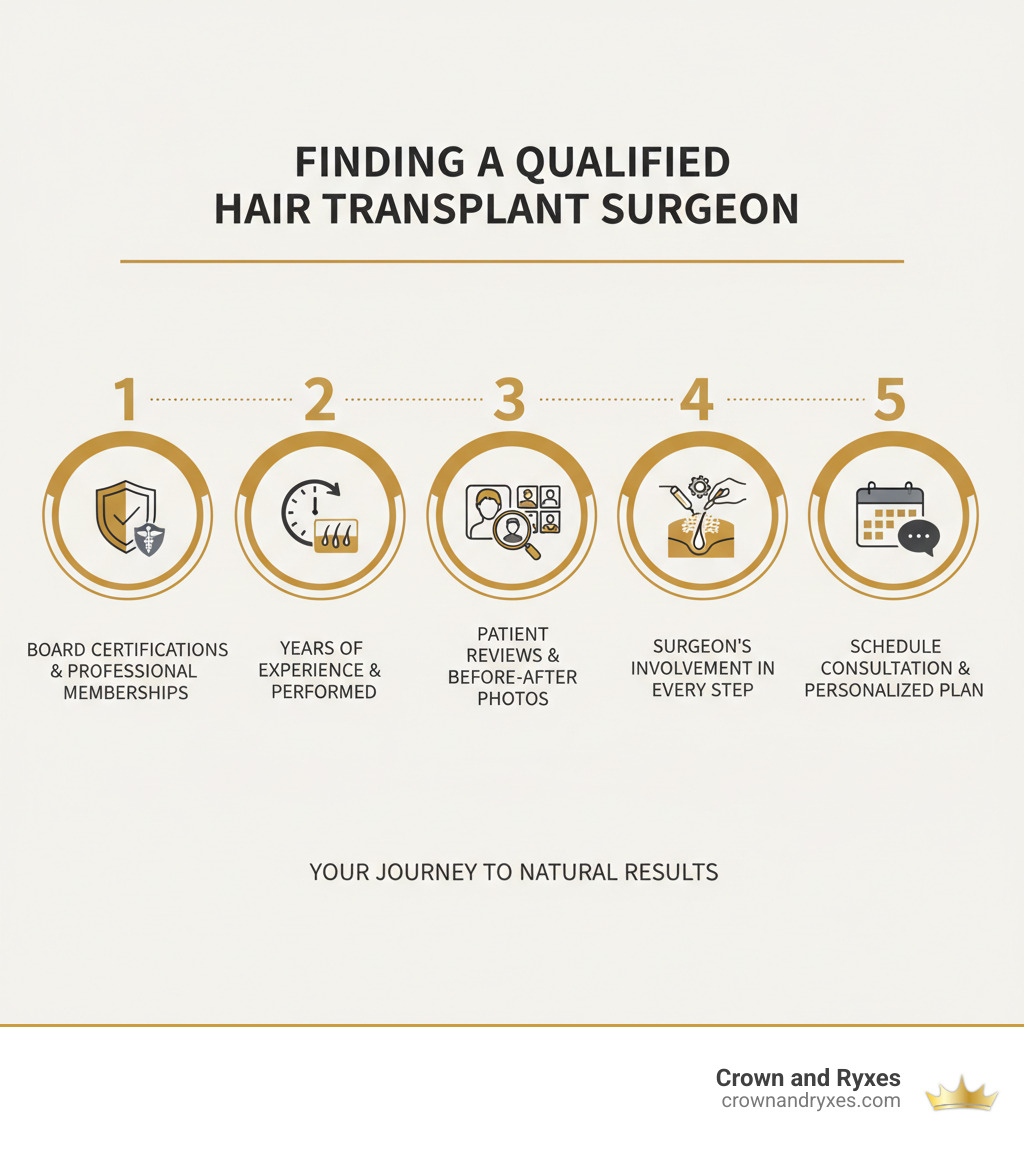
What Makes a Hair Transplant Surgeon “The Best”? Key Factors for Your Decision
Choosing a hair transplant surgeon is a critical decision. You need more than a medical professional; you need an artist who understands facial aesthetics, a technician with steady hands, and a partner who listens to your goals.
So what separates a good surgeon from the best hair transplant surgeon for you? Let’s break down the key factors.
Years of Practice and Volume of Procedures
Experience matters. The learning curve in hair transplantation is steep, and mastery comes only after years of practice and thousands of procedures. Most leading surgeons have been practicing for 10 to 30+ years, performing anywhere from 4,500 to over 20,000 hair transplants.
However, quality is more important than quantity. The best surgeons typically perform only 1-2 transplants per day. This allows them to be personally involved in every critical step, from designing your hairline to placing grafts with precision. This personalized approach makes all the difference in achieving careful execution and natural results. That’s the standard we uphold at Crown and Ryxes.
Verifiable Credentials and Board Certifications
Credentials are proof of expertise and a commitment to excellence. Look for a Board-Certified Dermatologist or Board-Certified Plastic Surgeon, as this indicates rigorous training in surgical techniques.
Because hair restoration is a specialized skill, membership in recognized societies is also crucial. The International Society of Hair Restoration Surgery (ISHRS) and the American Board of Hair Restoration Surgery (ABHRS) set the gold standard. Surgeons who achieve Fellow status (FISHRS) or become Diplomates (DABHRS) have passed extensive peer review and challenging exams. These credentials represent thousands of hours of study and dedication to ethical patient care. Take the time to verify these credentials when researching surgeons. Find a qualified hair transplant surgeon who meets these standards.
Analyzing Patient Reviews and Testimonials
While numbers and credentials tell part of the story, patient reviews reveal the actual experience. The best hair transplant surgeon candidates typically have average review scores of 4.5 out of 5 or higher. Don’t just look at the star rating—read what patients are saying.
Look for comments about natural-looking outcomes, the surgeon’s professionalism and bedside manner, and clear communication. Details about the surgeon’s personal involvement in designing the hairline or the quality of follow-up care paint a vivid picture of what you can expect.
Combine reviews with before-and-after photos to get a complete picture of a surgeon’s work. Our Hair Transplant Success Stories: Real Patient Testimonials and Results page showcases real changes. For help evaluating photos, our Hair Transplant Before and After: A Guide to the Transformation article explains what to look for.
Finding the right surgeon takes research, but it’s worth the effort to find someone who can deliver the natural, lasting results you deserve.
FUE vs. FUT: Finding a Specialist for Your Preferred Technique
When you’re searching for the best hair transplant surgeon, understanding the different techniques is as important as evaluating credentials. Not all surgeons excel at every method, and finding a specialist in the approach that fits your needs is key to a successful outcome.
The two primary techniques are Follicular Unit Extraction (FUE) and Follicular Unit Transplantation (FUT). Each has its own strengths, and the best choice depends on your unique situation.
The Rise of FUE: The Most Common Method
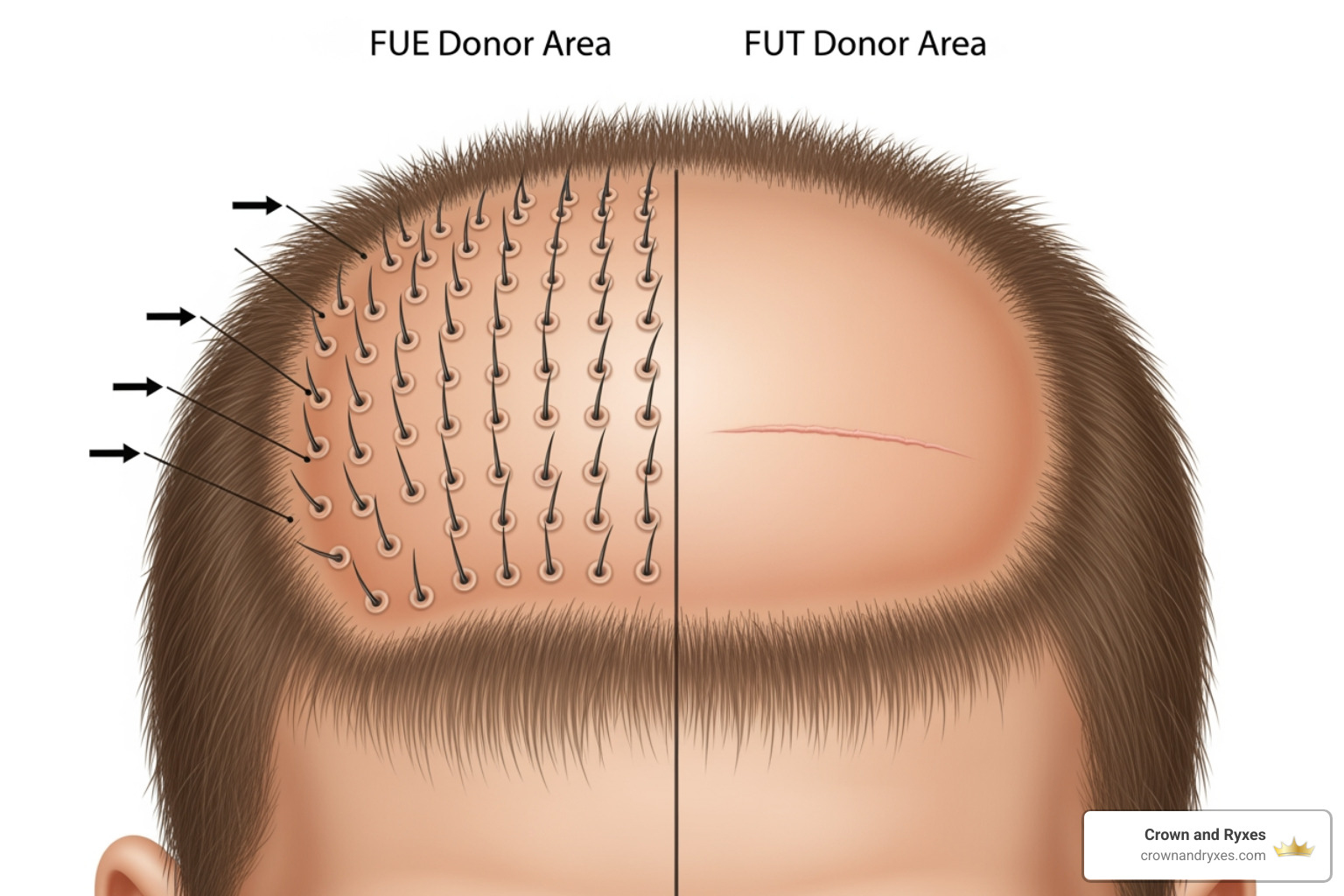
Follicular Unit Extraction (FUE) has become the most popular method worldwide. This minimally invasive technique involves extracting individual follicular units (groups of 1-4 hairs) directly from the donor area with a micro-punch tool.
FUE’s main appeal is that it leaves no linear scar. Instead, it creates tiny dot scars that are virtually invisible, allowing you to wear your hair very short. The procedure is also minimally invasive, leading to less discomfort and a shorter recovery time. Most patients return to normal activities within a few days.
Technology has advanced FUE even further. Robotic and semi-automated assistance can make the harvesting process faster and less traumatic to the scalp, improving the efficiency of the procedure.
FUE is ideal for patients who want to keep their hair short, have limited scalp elasticity, or wish to avoid a linear scar. We offer comprehensive FUE Hair Replacement services designed for natural-looking results. Research like Follicular Unit Extraction: Minimally Invasive Surgery for Hair Transplantation provides more insight into its effectiveness.
When FUT (Strip Method) is the Right Choice
While FUE is popular, Follicular Unit Transplantation (FUT), or the strip method, remains a powerful technique, accounting for 30% of hair transplants worldwide. For certain patients, it offers significant advantages.
In FUT, a strip of scalp is removed from the donor area and dissected under microscopes into individual follicular units. Its biggest benefit is maximizing graft yield, allowing surgeons to harvest a large number of grafts in a single session. If you have advanced hair loss and need substantial coverage, FUT can be the most efficient option.
FUT also typically has a lower cost per graft, which can be a factor for those on a budget. Additionally, the extraction method can preserve overall donor density well, since hair is removed from one concentrated area.
FUT is a great option for patients who need a large number of grafts, have extensive hair loss, or prefer to wear their hair longer, which easily conceals the linear scar. The choice between FUE and FUT is a personalized decision you’ll make with your surgeon. We ensure you understand every aspect of Hair Transplant Surgery: What You Need to Know About the Procedure so you can move forward with confidence.
Here’s a quick comparison:
| Feature | FUE (Follicular Unit Extraction) | FUT (Follicular Unit Transplantation) |
|---|---|---|
| Method | Individual follicles extracted directly | Strip of scalp removed, then dissected into follicles |
| Scarring | Tiny, scattered dots (almost invisible), no linear scar | Linear scar in donor area |
| Recovery | Faster, less discomfort, quick return to activity | Slightly longer, more initial discomfort |
| Ideal For | Short hairstyles, less extensive hair loss, scar avoidance | Extensive hair loss, maximizing graft yield, longer hairstyles |
| Cost Per Graft | Generally higher | Generally lower |
| Graft Yield | Can be limited in a single session | Can yield a very large number of grafts in one session |
Finding the best hair transplant surgeon means finding someone skilled in the technique that’s right for you—and who explains why one approach might be better for your specific needs.
Decoding Achievements: What Sets the Best Hair Transplant Surgeon Apart
When searching for the best hair transplant surgeon, you’ll find that exceptional doctors stand out for how they’ve shaped the field of hair restoration. These achievements are more than just credentials; they’re evidence of a surgeon’s dedication to advancing medical knowledge and improving patient outcomes.

Contributions to the Field
The leading hair transplant surgeons don’t just follow established protocols—they help create them. Their contributions often include:
- Pioneering techniques in hairline design, graft placement, or donor harvesting that become standard practice worldwide.
- Teaching and lecturing at major medical conferences, where they are recognized by the medical community as leaders and educators.
- Writing medical textbooks and publishing research, with many authoring numerous peer-reviewed articles and comprehensive textbook chapters.
- Innovating surgical tools and devices, some of which are adopted by surgeons globally and lead to better precision, faster recovery, or more natural results.
We are passionate about staying at the forefront of these developments, integrating the latest proven techniques into our Hair Restoration Solutions. Innovation isn’t just about being new—it’s about being better for you.
Leadership and Recognition
The medical community has its own ways of recognizing excellence, and these distinctions are important when choosing the best hair transplant surgeon.
- Serving on medical boards for organizations like the ISHRS or ABHRS means a surgeon is helping shape the standards and ethics of the entire profession.
- Awards for excellence, such as the Golden Follicle Award, provide external validation of a surgeon’s transformative contributions to the field. Being consistently listed in publications like “America’s Top Doctors” also reflects sustained excellence.
- Peer recognition is perhaps the most meaningful validation. When other specialists cite a surgeon’s work or select them for leadership roles in professional societies, it speaks volumes about their expertise.
These achievements indicate you’re choosing a surgeon who has earned the respect of their peers and is dedicated to advancing the field. That same level of expertise will be applied to your personal restoration journey.
The Consultation: Your Ultimate Vetting Tool
After narrowing down your list, the consultation is your most powerful decision-making tool. This is your opportunity to meet the surgeon, ask critical questions, and determine if it’s the right partnership for your hair restoration journey.
A quality consultation is a dialogue. The surgeon should be as interested in understanding your goals and concerns as you are in learning about their approach. This is where you’ll feel whether the patient-doctor communication clicks.
The best hair transplant surgeon will examine your scalp, discuss your hair loss pattern, and explain what’s realistically achievable. They will walk you through a custom treatment plan and set clear expectations to build a foundation of trust. For more guidance, check out our resource on choosing a Hair Transplant Clinic.
Key Questions to Ask Your Potential Surgeon
Come prepared with questions to understand the procedure and the team’s involvement.
- How many hair transplant procedures do you perform daily? A focus on one or two cases per day suggests a commitment to quality over quantity.
- Who performs the graft extraction and placement? The surgeon should perform the most critical steps, like designing the hairline and creating recipient sites.
- Can I see before-and-after photos of patients with similar hair loss patterns to mine? This helps you visualize realistic outcomes and assess the surgeon’s artistic skill.
- What are the potential risks and complications, and how do you mitigate them? A trustworthy surgeon will be transparent about risks and have clear protocols to manage them.
- What is your approach to hairline design? The surgeon should have a thoughtful philosophy for creating a natural look that suits your facial features and age.
- What is your philosophy on long-term hair loss management? A good surgeon will discuss strategies to maintain your results over time.
- What is included in the total cost, and what kind of follow-up care is provided? You deserve a clear, itemized breakdown and a plan for post-operative support.
Red Flags to Watch Out For
Trust your instincts. If something feels off during your consultation, pay attention. Here are some warning signs:
- High-pressure sales tactics. A reputable surgeon educates you and gives you space to decide. If you feel pushed to book immediately, walk away.
- Vague answers to specific questions. You deserve straight answers about experience, who performs the surgery, and potential risks.
- A lack of comprehensive before-and-after photos. A surgeon with a strong track record should have an extensive portfolio of diverse cases.
- Non-physicians performing key surgical steps. While technicians are vital, the surgeon’s direct involvement in critical phases is what you’re paying for.
- Unrealistic promises. If a surgeon guarantees perfect results or dismisses any possibility of complications, they are not being honest.
Finding the best hair transplant surgeon means being an informed patient. If something doesn’t feel right, seek a second opinion. Your hair and your confidence deserve a surgeon who earns your complete trust.
Frequently Asked Questions about Hair Transplants
Deciding on a hair transplant comes with many questions. We want you to feel confident and informed. Here are answers to some of the most common questions we hear.
How Much Does a Hair Transplant Cost in the USA?
The cost of a hair transplant in the USA depends on your unique treatment plan. The average cost per graft is approximately $5.44 USD. For a typical procedure of 2,500 grafts, the average total investment is around $13,610.00 USD, with a general range of $8,000 to $26,250.
Key factors influencing the price include:
- The type of procedure: FUE can sometimes have a higher per-graft cost than FUT due to its time-intensive nature.
- Surgeon’s experience: Highly skilled surgeons with extensive experience may have higher fees, which often translates to better results.
- Geographic location: Clinics in major metropolitan areas may have higher prices.
We believe in full transparency. During your consultation, we provide a detailed, itemized breakdown of all costs. For a comprehensive look at pricing, visit our page on How Much Does Hair Transplant Cost?.
How Long Until I See the Final Results?
Patience is key, as hair restoration follows natural growth cycles. Here is a typical timeline:
- First 2-4 weeks: The transplanted hairs will shed. This is a normal and expected phase known as “shock loss” as the follicles enter a resting period.
- 3-4 months: You’ll start to see initial, fine hair growth. It will still be sparse at this stage.
- 6-9 months: Significant, visible growth occurs. Hairs become thicker and more prominent, and the results become noticeable.
- 12-18 months: Your results reach full maturity. The transplanted hairs will have fully integrated, achieving their complete thickness and texture.
Everyone’s healing and growth rate is unique. For a detailed guide on your recovery, check out our article on The Recovery Process: What to Expect After a Hair Transplant.
What Are the Main Risks of Hair Transplant Surgery?
While hair transplant surgery is generally very safe with a skilled surgeon, it is a medical procedure with potential risks. The best hair transplant surgeon will discuss these openly with you.
Potential risks include:
- Infection: Rare when sterile techniques are used and post-op instructions are followed.
- Scarring: FUE leaves tiny, nearly invisible dot scars, while FUT creates a linear scar that is typically well-concealed by hair. A surgeon’s skill is crucial in minimizing scar visibility.
- Unnatural appearance: This is preventable by choosing an experienced, artistic surgeon who can design a natural hairline and place grafts correctly.
- Poor graft survival: A skilled surgeon with meticulous technique significantly reduces the risk of transplanted follicles failing to grow.
- Shock loss: Temporary shedding of existing hair around the transplanted area is common and usually resolves within a few months.
- Temporary side effects: Swelling in the forehead and numbness in the donor or recipient areas are common and usually resolve within a few weeks.
Choosing an experienced, board-certified surgeon who follows strict safety protocols dramatically minimizes these risks. For a comprehensive discussion, read our article on Hair Transplant Risks and Complications: What You Need to Know.
Conclusion
Your journey to finding the best hair transplant surgeon is deeply personal, and we hope this guide has given you the clarity and confidence to make the right choice. The “best” surgeon isn’t just the one with the most impressive credentials or the longest list of procedures—it’s the one who truly understands your unique needs, communicates openly, and demonstrates both the technical skill and artistic vision to help you achieve your goals.
We’ve covered the essential factors: the importance of experience and volume of procedures, the critical value of board certifications and professional memberships, the insights you can gain from patient reviews and before-and-after photos, and the differences between FUE and FUT techniques. We’ve explored what sets exceptional surgeons apart through their contributions to the field and recognition by their peers. And perhaps most importantly, we’ve emphasized how the consultation process serves as your ultimate vetting tool, where you can ask the right questions and watch for red flags.
At Crown and Ryxes, serving Clermont, FL, and The Villages, FL, we believe that your hair restoration journey should be as individual as you are. We’re committed to providing personalized solutions that deliver natural, lasting results—because we know that when you look good, you feel good. Our approach combines cutting-edge techniques with genuine care, ensuring you’re supported every step of the way.
Beyond hair restoration, we also recognize that wellness is holistic. That’s why we offer comprehensive sexual wellness solutions, including REGENmax, to support your overall vitality and confidence. Your personalized wellness journey is our priority, and we’re here to help you refind the best version of yourself.
Ready to take the next step? Explore our advanced Hair Loss Treatments and find how we can help you regain your confidence and live life to the fullest. You deserve to feel comfortable in your own skin, and we’re honored to be part of that journey with you.