

Understanding the True Cost of Body Hair Restoration
Body hair transplant cost typically ranges from $1,500 to $15,000, depending on the number of grafts needed, clinic location, and surgical technique used. This procedure moves hair follicles from areas like your beard, chest, or arms to restore thinning areas on your scalp or other body regions.
Quick Cost Breakdown:
– Per graft: $3-$12
– Total procedure: $1,500-$15,000
– Average session: 1,000-3,000 grafts
– Success rates: 50-95% (beard hair performs best at 95% survival)
Body hair transplantation isn’t new—it traces back to 1930s Japan where surgeons first performed eyebrow and eyelash grafts on injured soldiers. Today, this technique has evolved into a sophisticated solution for people who lack sufficient scalp donor hair or need additional grafts for extensive coverage.
The growing demand for body hair transplants stems from their ability to provide thousands of additional grafts when traditional scalp donor areas are exhausted. However, understanding the true cost goes beyond the base procedure fee—you’ll need to factor in consultation fees, anesthesia, facility charges, recovery supplies, and potential travel expenses.
As Dr. Matthew Casavant, I’ve spent over two decades helping patients understand complex medical procedures and their associated costs. My experience in advanced surgical techniques has given me deep insight into body hair transplant cost factors that patients often overlook when planning their restoration journey.
Basic body hair transplant cost vocab:
– fue hair implant
– fue hair replacement
– top fue hair transplant surgeons
How Body Hair Transplantation Works
Body hair transplantation opens up exciting possibilities when your scalp donor area can’t provide enough grafts for complete restoration. The procedure primarily uses Follicular Unit Extraction (FUE), though surgeons sometimes employ Follicular Unit Transplantation (FUT) in specific areas like the underarms where scars can hide naturally in skin folds.
Think of follicular units as nature’s perfect hair packages—small groups of 1 to 3 hair follicles that grow together. During the procedure, your surgeon carefully extracts these units from donor areas on your body and transplants them to areas needing coverage.
The FUE process for body hair requires specialized punches between 0.75 to 0.9 mm in diameter to minimize scarring on your body. Your surgeon will use local anesthesia with lidocaine and adrenaline, plus a tumescent solution to prepare the tissue for extraction. Each session typically takes 4 to 10 hours, depending on how many grafts you need.
Here’s where it gets interesting—success rates vary dramatically by donor area. Beard hair achieves an impressive 95% survival rate, making it the gold standard for body hair transplants. Chest hair follows with about 76% survival after one year. Other areas like arms and legs show more modest results, with roughly 25% of non-beard body hair transplants achieving cosmetically satisfying outcomes.
Scientific research on body hair FUE confirms that proper technique and careful patient selection make all the difference. The procedure involves three critical stages: extraction from donor sites, recipient site creation, and precise graft placement. Multiple team members often work simultaneously to keep grafts viable during these extended procedures—which directly impacts your body hair transplant cost.
Body vs Scalp Techniques
Body hair behaves quite differently from scalp hair, and understanding these differences helps explain why body hair transplant cost can vary significantly from traditional scalp procedures.
Growth cycle timing creates the biggest challenge. While your scalp hair grows continuously for 2-6 years, body hair has much shorter growth phases. Up to 60% of body hair may be resting at any given time, compared to scalp hair where most follicles stay actively growing.
Texture matching presents another consideration. Beard hair tends to be coarser and curlier than scalp hair, while arm and leg hair often appears much finer. This affects how natural your results look, especially in visible areas.
Extraction yields also differ significantly. Body hair requires more precise timing and technique, often resulting in higher transection rates of 10-30% compared to just 5-10% for scalp hair. This means surgeons need to harvest more grafts to achieve your desired density.
Corrective applications make body hair transplants particularly valuable. Many patients use body hair to correct previous procedures or address extensive baldness when scalp donor areas are exhausted. However, these cases typically require more grafts to achieve similar density compared to scalp-to-scalp procedures.
The longer extraction time and specialized technique requirements increase surgical time and associated fees, directly impacting your overall investment. More info about procedure details can help you understand the technical aspects that influence pricing.
Are You a Good Candidate? Donor & Recipient Zones
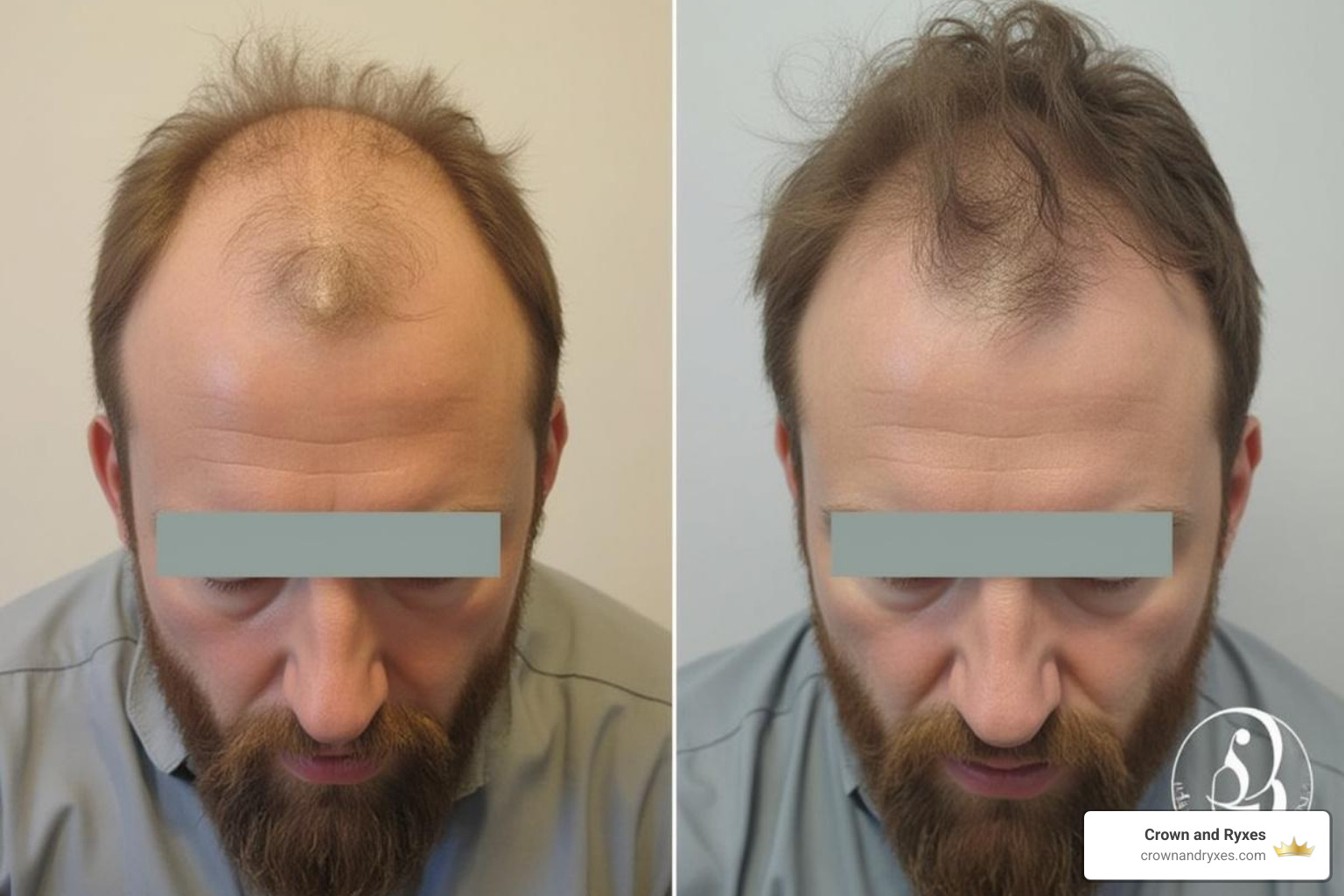
Not everyone is a good candidate for body hair transplantation, and honestly, that’s okay. Your success depends on having the right donor hair available and understanding what this procedure can realistically achieve for you.
The beard and under-chin area serves as our gold standard donor zone. These follicles behave most like scalp hair and give us that impressive 95% survival rate we mentioned earlier. Your chest hair comes in second place—it’s usually dense enough for good harvesting, though the texture might be slightly different from what grows on your head.
Arm hair works beautifully for delicate areas like eyebrow reconstruction or refining your hairline, while leg hair offers limited yield but can be useful in specific situations. Back hair varies dramatically from person to person, so we evaluate it case by case.
When it comes to recipient areas, we’re typically working with scalp zones affected by male pattern baldness—especially Norwood stages 4 through 7 where traditional scalp donor hair isn’t sufficient. We also see excellent results with eyebrow reconstruction, scar camouflage from previous surgeries, and even chest hair improvement or beard filling for patchy growth.
The body hair transplant cost often reflects the complexity of matching donor hair to recipient areas. Dense, dark body hair that closely matches your recipient zone in thickness and curl pattern gives us the best foundation to work with.
More info about risks helps you understand all aspects of candidacy before making your decision.
Candidacy Checklist
Age matters more than you might think. We recommend waiting until you’re at least 25 years old because your hair loss pattern needs to stabilize first. There’s no point in designing a restoration plan if your hairline is still changing.
Good overall health is non-negotiable since you’ll be sitting through a 4 to 10-hour procedure under local anesthesia. We need to know you can handle the extended surgical time comfortably.
Adequate donor hair quality and density in your body areas makes the difference between success and disappointment. We’re looking for hair that’s thick enough to survive transplantation and similar enough to your recipient area to look natural.
Realistic expectations might be the most important factor of all. Body hair behaves differently than scalp hair—it has different growth cycles, textures, and characteristics. Understanding this upfront prevents disappointment later.
Non-smokers heal better and see higher graft survival rates. If you smoke, we’ll need to discuss cessation before your procedure.
Women candidates face unique challenges since they typically have less body hair available for harvesting. This limitation directly affects both feasibility and body hair transplant cost.
People with cicatricial alopecia or scarring conditions may need test grafting first to see if their scalp will accept transplanted follicles. Those who’ve had previous failed procedures often find body hair transplantation helps supplement inadequate results.
We don’t recommend this procedure if you’re under 24, have insufficient or poor-quality donor hair, or have serious health conditions that increase surgical risks. Genetic factors like extensive family baldness patterns might actually work in your favor—they often indicate you’ll need those body hair reserves eventually.
Scientific research on hair transplantation continues to refine our understanding of who benefits most from these procedures.
Body Hair Transplant Cost: What You’ll Really Pay
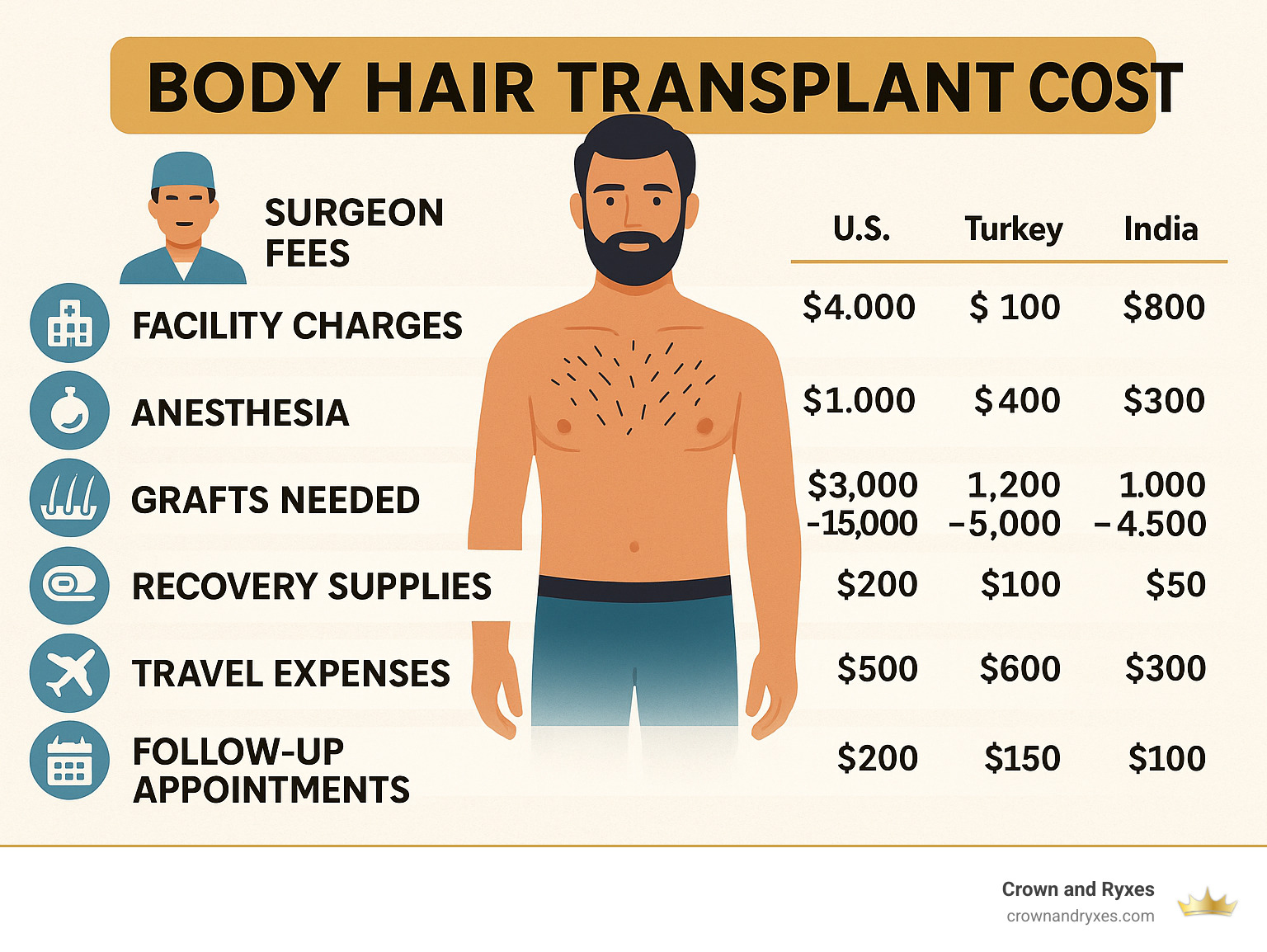
When you’re considering body hair restoration, the body hair transplant cost can feel overwhelming at first glance. Most patients invest between $1,500 and $15,000 for their procedure, with the final price depending on how many grafts you need, where you have it done, and which technique your surgeon uses.
Here’s what drives those numbers: each graft typically costs $3 to $12, and most people need anywhere from 1,000 to 3,000 grafts per session. The math adds up quickly, but understanding what you’re paying for helps put these figures in perspective.
| Location | Cost Range | Per Graft | What’s Included |
|---|---|---|---|
| United States | $4,000-$15,000 | $7-$12 | Full facility fees, anesthesia, follow-up care |
| Turkey | $2,000-$6,000 | $2-$4 | Popular for medical tourism, variable standards |
| India | $1,500-$5,000 | $1.50-$3 | Significant savings but quality varies widely |
At our Clermont and The Villages locations, we believe in transparent pricing that covers everything you need for a successful procedure. No surprise bills or hidden fees that pop up later.
The surgeon’s fee makes up the biggest chunk—usually 40% to 60% of your total cost. This reflects the specialized skill needed for body hair extraction, which is significantly more complex than traditional scalp procedures. Facility charges account for another 20% to 30%, covering the operating room, equipment, and support staff. Anesthesia and medications add 10% to 15%, while pre and post-operative care rounds out the remaining costs.
More info about cost factors can help you understand exactly what influences pricing for your specific situation.
Comparing Body Hair Transplant Cost vs Scalp Transplant Cost
Here’s something that surprises many patients: body hair transplant cost runs about 20% to 40% higher than equivalent scalp procedures. There’s a good reason for this price difference, and it comes down to the technical challenges involved.
Extraction takes much longer with body hair. Your surgeon needs to use more precise techniques, and each graft requires extra care during removal. This extends your procedure time from the typical 4-6 hours for scalp work to 8-10 hours for body hair harvesting.
Higher transection rates also impact costs. More grafts get damaged during body hair extraction compared to scalp hair, so your surgeon needs to harvest additional grafts to reach your target number. It’s like buying extra ingredients when you’re cooking because you know some will get wasted in preparation.
Variable growth patterns mean body hair doesn’t always behave predictably after transplantation. While beard hair performs nearly as well as scalp hair with 95% survival rates, chest hair only achieves about 76% success. This often means you’ll need more grafts upfront or a follow-up procedure to achieve your desired density.
The artistic skill required to blend body and scalp hair naturally also adds to the complexity. Your surgeon needs extensive experience to create results that look completely natural, and that expertise commands higher fees.
Factors That Drive Price Up or Down
Several key factors can dramatically swing your body hair transplant cost in either direction. Understanding these helps you budget accurately and make informed decisions about your procedure.
Your graft count has the biggest impact on pricing. Procedures requiring 3,000 or more grafts will naturally cost significantly more than smaller 500-1,500 graft sessions targeting specific areas. Think of it like renovating your home—a full restoration costs more than touching up a single room.
The FUE technique costs more than FUT because it’s much more labor-intensive. Each follicle gets extracted individually rather than removing a strip of tissue, which means more time and precision from your surgical team.
Geographic location plays a huge role in pricing. Our Florida locations in Clermont and The Villages offer competitive rates compared to major metropolitan areas like New York or Los Angeles, while maintaining the same high standards of care and expertise.
Surgeon experience with body hair procedures commands premium pricing, and for good reason. Board-certified specialists who regularly perform body hair transplants achieve better results and fewer complications. This isn’t the place to bargain hunt—your results depend heavily on your surgeon’s skill.
Facility standards also influence costs. Accredited surgical centers with advanced equipment and experienced staff cost more to operate, but they provide safer procedures and better outcomes.
On the cost-saving side, smaller targeted procedures cost less than full restoration sessions. Package deals that combine multiple sessions or procedures can offer savings. Timing your procedure during off-peak periods might provide modest discounts, though this varies by practice.
Hidden Fees That Raise Body Hair Transplant Cost
The sticker price for your procedure is just the beginning. Several additional expenses can add hundreds or even thousands to your total investment, and many patients don’t think about these until they’re already committed.
Travel costs hit hardest for out-of-area patients. Hotel stays run $100 to $200 per night, and you’ll likely need accommodation for several days. Add flights, rental cars, gas, and meals during recovery, plus expenses for a companion if they’re traveling with you. These costs can easily reach $1,000 to $2,000 for patients traveling from other states.
Recovery supplies seem minor but add up quickly. Prescribed medications cost $50 to $200, special shampoos and care products run $30 to $100, and you’ll need protective clothing and special pillows that add another $25 to $75. Some patients also invest in additional treatments like PRP therapy, which costs $300 to $800 per session.
Lost income often catches people off guard. Most patients need 3 to 7 days off work, and your productivity might be reduced for several weeks during early recovery. If complications arise—which happens in 10% to 20% of cases—you might need additional time off.
Follow-up care usually includes check-up appointments that are covered in your initial fee, but travel costs to reach these appointments aren’t. Touch-up procedures, needed by about 10% to 20% of body hair transplant patients, represent additional investment in your results.
More info about before/after expectations helps you plan for the complete recovery process and budget for all associated costs upfront.
Recovery, Risks, Success Rates & Financing
Understanding what happens after your body hair transplant helps you prepare for both the recovery journey and the financial commitment involved. The healing process takes patience, but the results can be life-changing when you know what to expect.
Body hair transplant cost includes more than just the procedure—you’ll want to factor in recovery time, follow-up care, and any additional treatments that might improve your results. Most patients find the investment worthwhile when they see their final outcomes.
Success rates vary significantly depending on which donor area we use. Beard hair gives us the best results at 95% survival rate, making it our go-to choice when possible. Chest hair follows at around 76% survival after one year, while other body areas typically range from 50-80% depending on your individual factors and the technique used.
The risks are generally minimal when you choose an experienced surgeon. Temporary shock loss in surrounding hair is completely normal and expected—don’t panic when this happens. Minor bleeding or infection occurs in less than 2% of cases, and most patients experience only mild discomfort during healing.
Some patients benefit from PRP therapy to boost healing and graft survival. For those interested in comprehensive wellness, our REGENmax treatments can support overall health factors that impact hair growth and recovery.
More info about success stories from our patients shows what realistic outcomes look like and helps set proper expectations.
Post-Op Timeline & Care
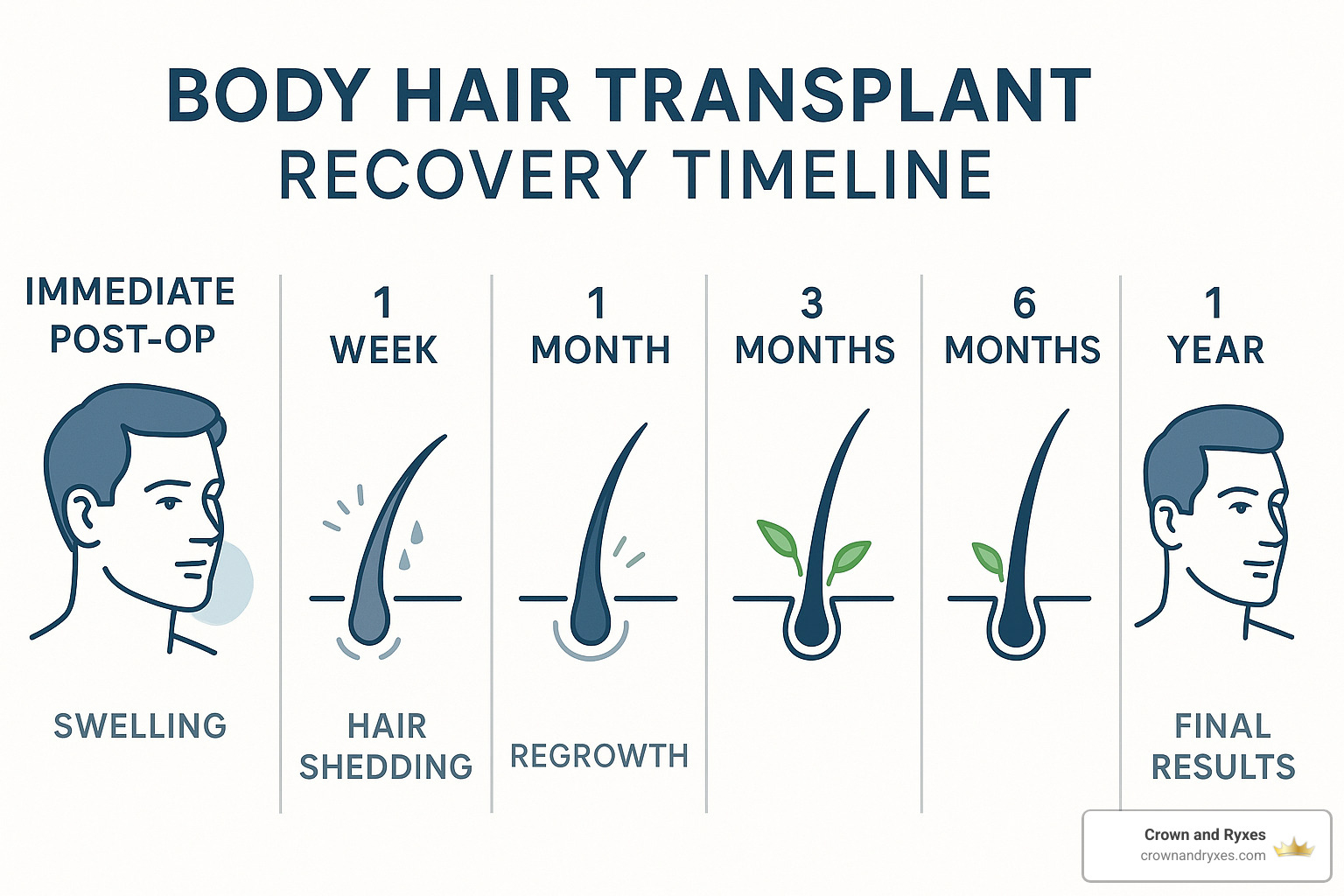
The first week is all about protecting your investment. Your donor areas need gentle care with prescribed ointment, and you’ll wash with diluted shampoo—nothing fancy, just careful attention. Small crusts form around the transplanted grafts, which might look concerning but are completely normal.
Weeks 2-6 bring the shedding phase, and this is where many patients worry unnecessarily. The transplanted hairs will fall out—this is supposed to happen! Think of it as the follicles settling in for the long haul. Your donor areas heal with minimal scarring during this time, and you can return to most normal activities.
Months 3-6 are when the magic starts. New hair growth begins emerging, and you’ll see your first real results. The texture and color might look different initially, but don’t worry—everything evens out as the hair matures.
Months 6-15 reveal your final results. This is when you’ll see the full density and natural appearance you’ve been waiting for. Most of our patients in Clermont and The Villages are thrilled with their results by this point, though everyone’s timeline varies slightly.
The key is patience. Hair doesn’t grow overnight, but when it does, the results last a lifetime.
Risk Mitigation & Long-Term Outcomes
Smart choices during recovery make a huge difference in your final results. PRP therapy can boost graft survival by 10-20%, which is why we often recommend it for our patients. Following aftercare instructions precisely—even when they seem overly cautious—directly impacts how well your transplant turns out.
Lifestyle factors matter more than you might think. Smoking is particularly harmful during healing, cutting off blood flow to your new grafts. Good nutrition supports healthy hair growth, and protecting your scalp from sun damage during those early weeks prevents complications.
Long-term considerations are generally positive. Your transplanted body hair continues growing and behaves like scalp hair, though you might need periodic trimming to maintain your desired style. If hair loss progresses in untreated areas, additional procedures remain possible.
Quality of life improvements extend far beyond appearance. Most patients report increased confidence and self-esteem that affects every area of their lives. The natural appearance, when performed skillfully, means most people will never know you had work done—they’ll just notice you look great.
The satisfaction rates speak for themselves. Our patients consistently rate their experience highly years after their procedure, with most saying they’d make the same choice again.
Paying for Your Procedure
Financing your body hair transplant doesn’t have to strain your budget if you plan ahead. CareCredit offers healthcare-specific financing with promotional 0% APR periods that many of our patients find helpful. We also work with patients on in-house payment plans that spread the cost over manageable monthly payments.
Health Savings Accounts (HSAs) sometimes cover hair transplant costs, particularly when there’s a medical component like scarring from burns or accidents. It’s worth checking with your HSA administrator about eligibility.
Insurance rarely covers hair transplants since they’re typically considered cosmetic procedures. However, in cases involving medical scarring or certain conditions, partial coverage might be possible with proper documentation and medical necessity justification.
Budget planning should include the full picture. Get detailed written estimates that include all fees—not just the base procedure cost. Factor in recovery time and any lost income, especially if your job requires physical activity. Consider starting with a smaller procedure and building over time if the full treatment exceeds your current budget.
Package deals for multiple sessions can offer savings, and planning for potential touch-up procedures prevents financial surprises later. About 10-20% of patients benefit from minor touch-ups to achieve optimal density.
More info about services we offer includes detailed information about financing options and payment structures that work for different budgets and situations.
Alternatives & Complementary Solutions
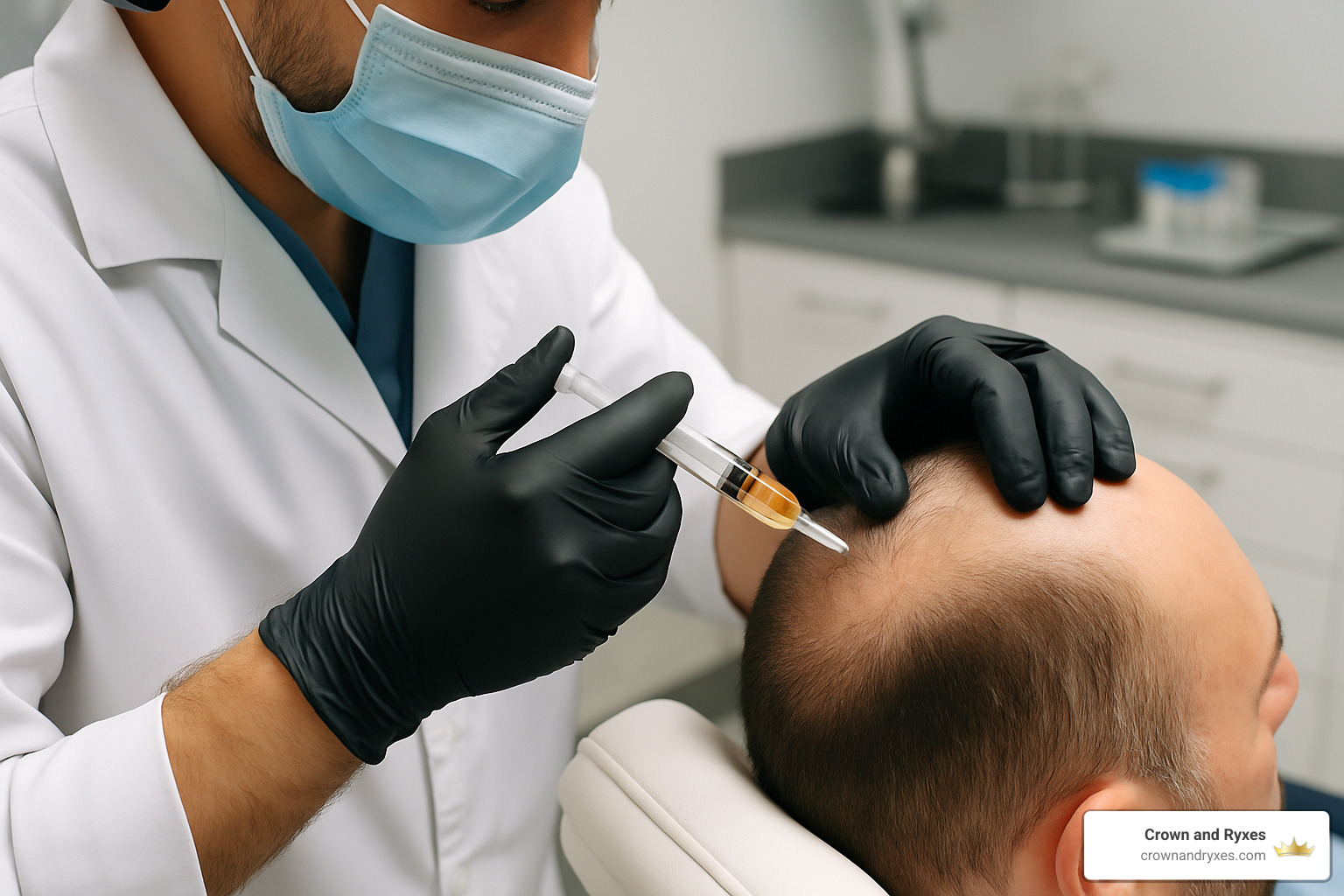
Not everyone needs to jump straight into body hair transplantation. If you’re dealing with early-stage hair loss or want to explore less invasive options first, several alternatives might work well for your situation—and your budget.
Minoxidil (the active ingredient in Rogaine) remains one of the most accessible starting points. This topical treatment costs around $20-40 monthly and can help thicken existing hair. The catch? It won’t magically create new follicles where you’ve already lost hair completely. Think of it as a way to maximize what you still have rather than restore what’s gone.
Finasteride offers another medication-based approach, particularly effective for men experiencing male pattern baldness. At about $10-80 per month, it works by blocking the hormone that causes hair loss. However, like minoxidil, it only helps where hair still exists—it can’t bring back completely bald areas.
For those interested in technology-based solutions, low-level laser therapy has shown promise in improving hair thickness and density. These devices range from $200 handheld units to $3,000 professional-grade caps. The results tend to be modest but can complement other treatments effectively.
Microneedling represents an interesting middle ground between topical treatments and surgery. This technique stimulates blood flow to hair follicles and may improve the effectiveness of other treatments like minoxidil. Professional sessions cost $100-300, while at-home devices run $15-100.
Scalp micropigmentation takes a completely different approach—instead of growing hair, it creates the appearance of hair through specialized tattooing. At $1,000-4,000 total, it costs less than most transplant procedures while providing immediate visual results.
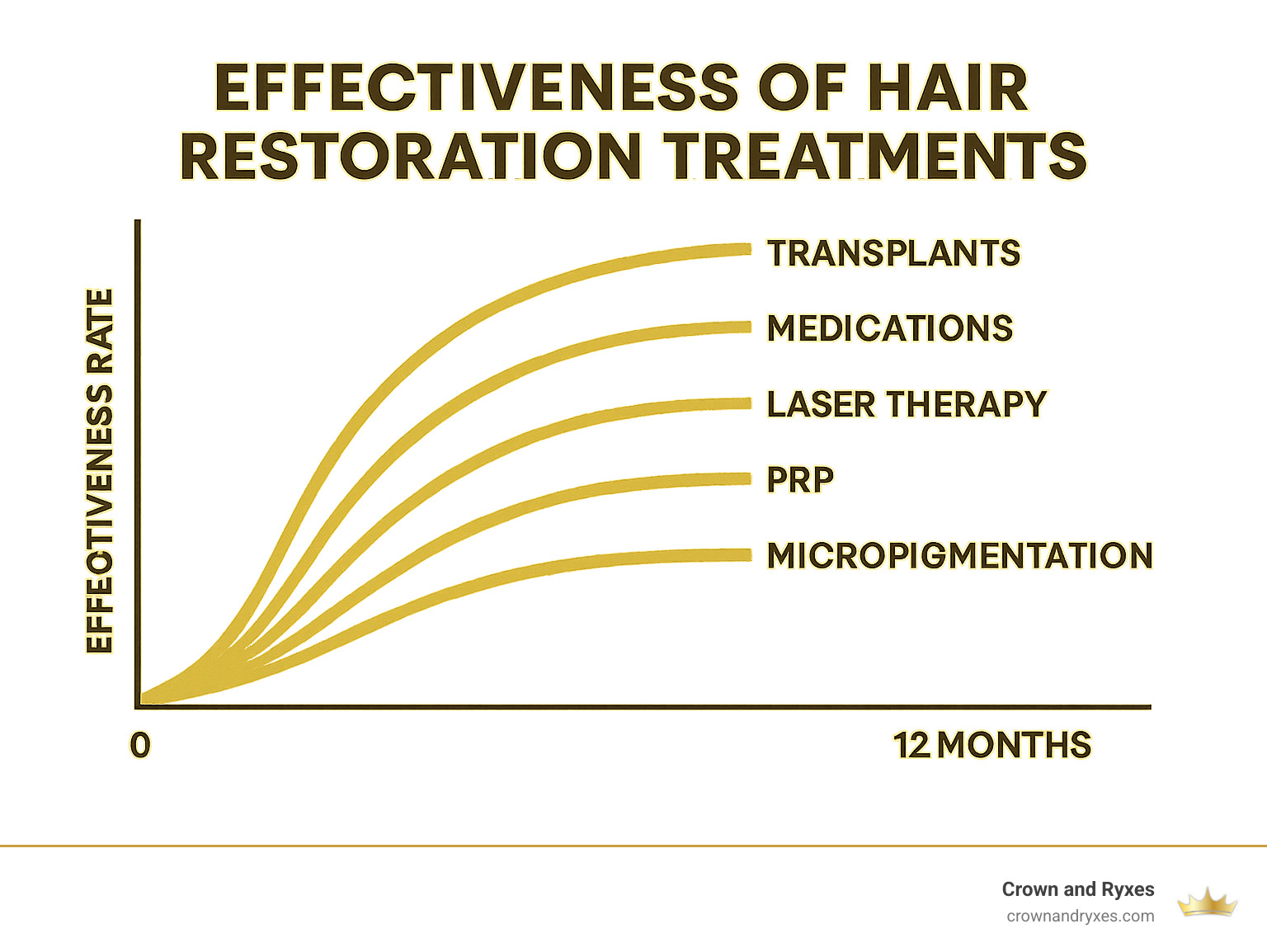
PRP therapy deserves special mention as both an alternative and complement to transplantation. This treatment uses your own blood platelets to stimulate hair growth and improve healing. At our Clermont and The Villages locations, we often recommend PRP alongside transplant procedures to boost graft survival rates by 10-20%.
For patients seeking comprehensive wellness solutions, our REGENmax treatments address underlying health factors that impact hair growth and overall vitality. Sometimes hair loss connects to broader wellness issues that benefit from a holistic approach.
The reality is that non-surgical treatments work best for people with early-stage hair loss who still have reasonable hair density. If you’re dealing with extensive baldness or completely smooth areas, these alternatives probably won’t give you the dramatic results you’re hoping for. However, they can be excellent for maintaining and optimizing results after a body hair transplant cost investment.
Many patients find success combining approaches—using medications to preserve existing hair while planning surgical restoration for areas of complete loss. This strategy can actually reduce your overall body hair transplant cost by minimizing the number of grafts needed.
The key is setting realistic expectations. While a $30 monthly medication sounds appealing compared to a $8,000 procedure, it won’t deliver the same level of change. But for the right candidate at the right stage of hair loss, these alternatives can provide meaningful improvement at a fraction of the surgical cost.
Frequently Asked Questions About Body Hair Transplant Cost
How many grafts can be taken from beard or chest?
Your beard area is like a goldmine for hair transplants—it typically provides 1,000 to 2,500 high-quality grafts that behave most like your natural scalp hair. The beard gives us the best survival rates and most natural-looking results, which is why we often start there when planning your procedure.
Your chest can be even more generous, potentially yielding 1,500 to 3,500 grafts depending on your natural hair density. However, chest hair tends to have a different texture and growth pattern compared to scalp hair, so we carefully evaluate how well it will blend with your existing hair.
Most patients benefit from combined harvesting from multiple areas. For example, we might take 1,500 grafts from your beard and 2,000 from your chest for a total of 3,500 grafts in one session. This approach gives us more options while avoiding over-harvesting any single area.
The total number available depends on your individual hair density and how much we can safely take without creating noticeable thinning in the donor areas. During your consultation, we’ll map out exactly what’s available and create a harvesting plan that maximizes your body hair transplant cost value.
Is any part of the cost covered by insurance?
Unfortunately, insurance coverage for body hair transplants is about as rare as finding a four-leaf clover. Since these procedures are typically classified as cosmetic, most insurance companies won’t contribute to your body hair transplant cost.
However, there are some exceptional circumstances where partial coverage might be possible. If your hair loss resulted from burns, accidents, or medical trauma, insurance may consider it reconstructive rather than cosmetic. Similarly, scarring from medical procedures or certain congenital conditions affecting hair growth might qualify for coverage.
The documentation requirements are extensive—you’ll need medical necessity justification from your physician, photos documenting your condition, proof of failed conservative treatments, and sometimes psychological impact assessments. Even when coverage applies, it typically only covers the reconstructive aspects, not aesthetic improvements.
Our advice? Plan to pay the full cost out of pocket and consider any insurance contribution a pleasant surprise. We offer financing options through CareCredit and other programs to help make your procedure more manageable financially.
When will I see the final results?
Patience is definitely a virtue when it comes to hair transplants. Your body hair transplant cost investment requires time to show its full value, but the wait is worth it for most patients.
The first 2-3 weeks can be a bit discouraging as some transplanted hairs shed—but don’t panic! This is completely normal and expected. Your scalp is healing, and the follicles are preparing for their new growth cycle.
Around 3-4 months, you’ll start seeing the magic happen. New growth begins emerging from the transplanted follicles, and you’ll get your first glimpse of the results to come. This is when most patients start getting excited about their decision.
By 6-9 months, significant improvement becomes clearly visible. Friends and family will start noticing the difference, and you’ll feel more confident about your appearance. The hair continues thickening and maturing during this phase.
Final results appear at 12-15 months after your procedure. This represents the permanent outcome you can expect long-term. The hair will continue growing normally and can be cut, styled, and treated just like your natural hair.
Several factors influence your timeline, including which donor area we used (beard hair typically grows faster than chest hair), your individual healing response, and how well you follow post-operative care instructions. Patients who use adjunct treatments like PRP often see slightly faster and better results.
The extended timeline requires patience, but remember—you’re investing in a permanent solution that will benefit you for decades to come.
Conclusion
Planning for body hair transplant cost means looking at the complete picture—not just the $1,500-$15,000 procedure fee, but also the travel expenses, recovery supplies, time off work, and possible follow-up treatments that come with your restoration journey.
At Crown and Ryxes, we’ve built our practice around honest conversations and personalized care. Our experienced FUE team in Clermont and The Villages understands that choosing body hair transplantation is a significant decision, both financially and personally. That’s why we take time to explain every cost component upfront, so you never face unexpected surprises.
Your investment goes beyond just hair. When patients tell us about the confidence they’ve gained and how much better they feel about themselves, we’re reminded why this work matters so much. The permanent nature of transplanted hair means you’re making a one-time investment that can improve your quality of life for decades to come.
We know every person’s situation is unique. Maybe you’re dealing with extensive hair loss that traditional scalp transplants can’t fully address. Perhaps you have scarring from a previous procedure that needs correction. Or you simply want to achieve better density than your scalp donor area can provide alone. Whatever brings you to consider body hair transplantation, we’re here to help you understand if it’s the right choice for your specific needs and budget.
Financing shouldn’t be a barrier to feeling confident again. We work with you to explore payment plans, healthcare credit options, and timing that makes sense for your financial situation. Some patients choose to start with smaller procedures and build over time, while others prefer comprehensive treatment in fewer sessions.
For those interested in supporting their overall health during the restoration process, our REGENmax treatments can complement your hair restoration journey by addressing wellness factors that impact healing and hair growth.
Ready to take the next step? More info about FUE services can help you understand exactly what’s involved. We’ll schedule a thorough consultation where we can discuss your goals, examine your donor areas, and provide a detailed cost estimate custom to your specific situation.
The best body hair transplant cost is the one that gives you natural-looking results and renewed confidence that lasts a lifetime. Let’s work together to make that investment as smart and successful as possible.