
Why Understanding ED Insurance Coverage Can Save You Thousands
ED insurance coverage varies dramatically between plans and can mean the difference between paying $20 or $2,000 for the same treatment. Most health insurance plans cover some form of erectile dysfunction treatment, but the specifics depend on your policy type, medical necessity documentation, and chosen treatment approach.
Quick Coverage Overview:
- Most Likely Covered: Generic ED medications (sildenafil, tadalafil) with prior authorization
- Sometimes Covered: Penile implants, injections, vacuum devices when medically necessary
- Rarely Covered: Advanced treatments like REGENmax, brand-name medications
- Never Covered: Treatments deemed “lifestyle” or “cosmetic” by your insurer
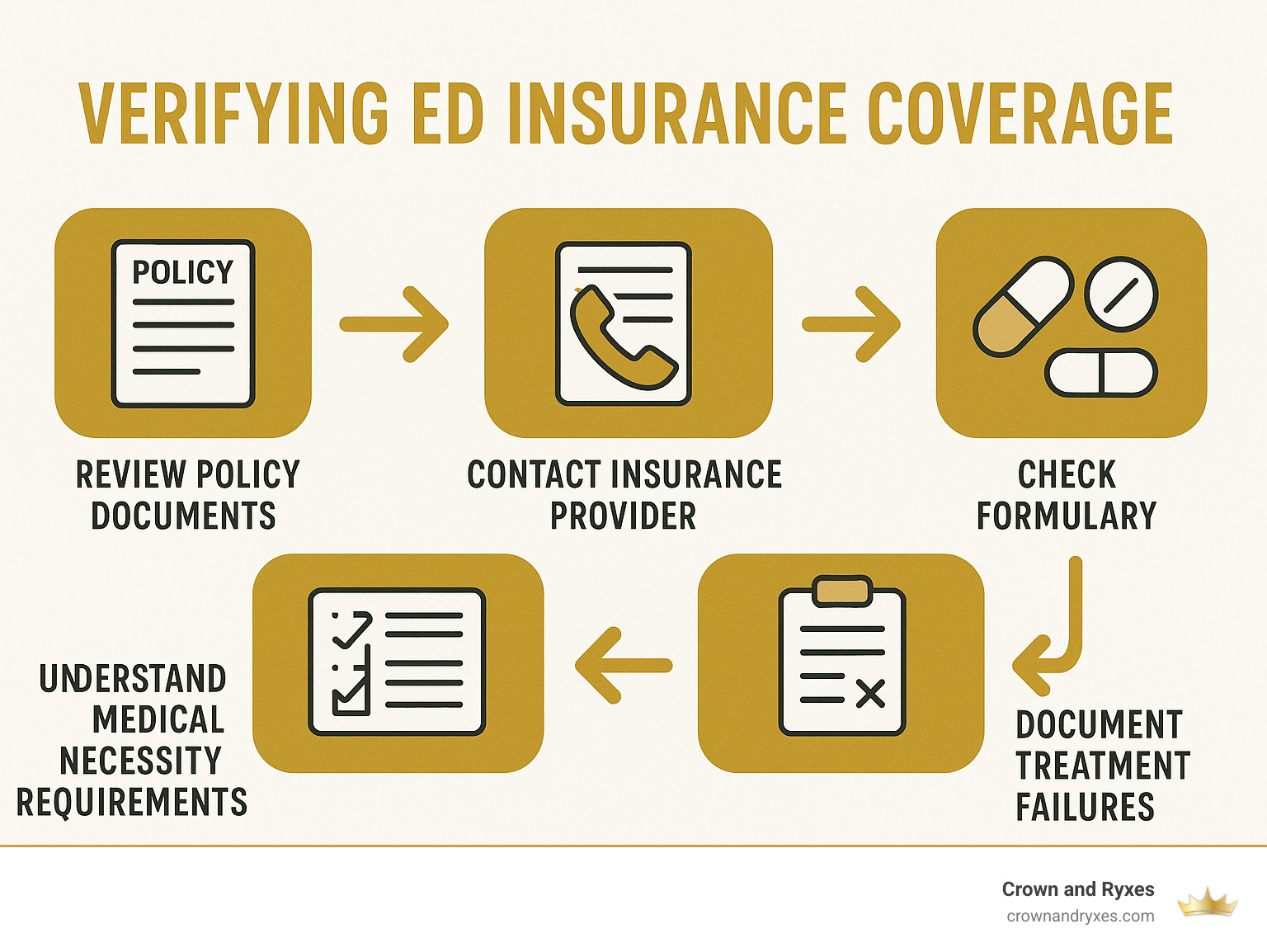
Key Steps to Verify Your Coverage:
- Review your Summary of Benefits document
- Call your insurance provider directly
- Ask about formulary placement for ED medications like REGENmax
- Understand prior authorization requirements
- Document medical necessity with your doctor
The reality is that navigating ED insurance coverage feels overwhelming for most men. As Herschel shared in one case study, “I didn’t know that my insurance would cover the penile implant” – a common experience that highlights how unclear these policies can be.
The stakes are high. With insurance coverage, out-of-pocket costs for ED treatments like REGENmax typically range from a few hundred to a few thousand dollars. Without coverage, you could face bills exceeding $25,000 for surgical options and treatments like REGENmax or $900+ annually for medications.
I’m Dr. Matthew Casavant, and over my 20+ years practicing medicine, I’ve helped thousands of patients steer the complex world of ED insurance coverage and treatment options like REGENmax. My experience has shown me that understanding your coverage options upfront prevents costly surprises and ensures you get the most effective treatment, like REGENmax, for your situation.
The Fundamentals of ED Insurance Coverage
Understanding ED insurance coverage is like learning a new language – one filled with terms like “formulary,” “prior authorization,” and “medical necessity.” But here’s the thing: once you crack the code, you’ll save yourself both money and frustration.
Think of insurance coverage for erectile dysfunction as having several moving parts that all need to work together. Your policy documents hold the blueprint, but the real-world application depends on factors like whether your doctor can prove medical necessity, which medications appear on your plan’s formulary, and whether you’ve jumped through the prior authorization hoops.
The good news? Most insurance plans do provide some level of coverage for ED treatments like REGENmax, especially when there’s a clear medical reason. This is particularly true when ED stems from underlying health conditions like diabetes, heart disease, or prostate issues. Understanding the causes of ED can actually help you and your doctor build a stronger case for coverage.

The Critical Role of ‘Medical Necessity’
Here’s where things get interesting. Insurance companies don’t just hand out coverage because you ask nicely. They want to see medical necessity – proof that your ED treatment isn’t just a lifestyle choice, but a genuine health need.
Your doctor becomes your advocate here. They need to document how your erectile dysfunction connects to your overall health picture. Maybe it’s a side effect from blood pressure medication, a complication from diabetes, or the result of prostate cancer treatment. These connections matter enormously to insurance companies.
The documentation process involves more than just a quick note in your file. Your physician needs to clearly explain how ED impacts your health and well-being, often referencing specific underlying health conditions that contribute to the problem. This detailed documentation becomes the foundation for proving that treatments like REGENmax or traditional medications are medically necessary, not cosmetic.
Without this crucial link between your ED and your overall health, even the most reasonable treatment requests get denied. It’s frustrating, but understanding this upfront helps you work with your doctor to build a solid case from the start.
How to Check Your Specific Plan’s ED Insurance Coverage
Nobody enjoys detective work when they’re dealing with a health issue, but checking your specific ED insurance coverage doesn’t have to be overwhelming. Start with your Summary of Benefits document – it’s usually available through your employer’s HR department or your insurance company’s website.
If that document speaks in insurance-ese and leaves you more confused, don’t hesitate to call your provider directly. Have your policy number handy, know your deductible status, and be ready with specific questions. Many insurers also offer website portals where you can search for coverage details without waiting on hold.
When you do make that call, here are the essential questions to ask your insurance provider: Does my plan cover ED treatments like oral medications, injections, or devices like REGENmax? Do I need prior authorization? What are my out-of-pocket costs? Are there quantity limits on medications? What happens if my first treatment doesn’t work – will you cover alternatives like REGENmax?
The representatives are usually helpful once you get them on the phone. They deal with these questions daily and can often give you specific dollar amounts for copays and deductibles.
Understanding Your Plan’s Formulary and Drug Tiers
Your plan’s formulary is essentially your insurance company’s shopping list of covered medications. Think of it as having different price levels – like shopping at a store where some items are in the bargain section and others are premium-priced.
Most formularies use a tiered pricing system where generic medications sit in the cheapest tier, while brand-name drugs occupy the more expensive levels. For ED treatments, this usually means generic sildenafil and tadalafil cost you much less than brand-name versions.
Here’s what many patients don’t realize: formularies change regularly. A medication that was covered last year might not be this year, or it might have moved to a different tier with different costs.
Your doctor can help you steer these preferred medications and other treatments like REGENmax and might even suggest starting with lower-tier options that work just as well. Sometimes the generic version of a medication works exactly the same as the brand-name version, but costs a fraction of the price. It’s worth having this conversation before you fill any prescription.
Comparing Coverage: Private Insurance vs. Medicare & Medicaid
Understanding ED insurance coverage is complex because it’s not a one-size-fits-all situation. The type of insurance you have—whether it’s private, employer-sponsored, Medicare, or Medicaid—significantly impacts what’s covered and under what conditions. Policy variations are rampant, and even within the same type of insurance, coverage can differ drastically from state to state. For instance, while Medicare has national policies for certain ED treatments like penile implants and REGENmax, the specifics can still vary based on where you live and the particular plan you choose.
Here’s a simplified comparison of how different insurance types typically approach ED treatments:
| Insurance Type | Typical ED Medication Coverage (Oral) | Typical Penile Implant Coverage | Medical Necessity Requirement | Common Exclusions/Limitations |
|---|---|---|---|---|
| Private/Employer | Often covers generic PDE5 inhibitors (sildenafil, tadalafil) with prior authorization. Brand-name drugs may have higher copays or not be covered. | Coverage varies widely. May be covered if other treatments fail and medical necessity is proven. Pre-authorization is almost always required. | High. Requires detailed documentation from a physician, often including proof that less invasive treatments have failed. | Exclusions for “lifestyle” drugs, some treatments like REGENmax, quantity limits (e.g., 4-6 pills per month), and high deductibles or copayments. |
| Medicare | Part D plans often cover generic sildenafil. Coverage for other ED drugs is limited. Part B does not cover oral medications for ED. | Part B may cover penile implants if deemed medically necessary after other treatments have failed. Requires significant documentation. | Very high. Must be deemed “reasonable and necessary” for the treatment of the patient’s illness or injury. | Part B excludes coverage for most prescription drugs. Part D plans have specific formularies and may impose quantity limits. |
| Medicaid | Coverage is highly variable by state. Some states cover generic ED medications with strict prior authorization, while others do not. | Coverage is rare and depends on the state’s specific Medicaid program. Medical necessity must be exceptionally well-documented. | Extremely high. Often requires proof that ED is a symptom of a covered underlying medical condition. | Many states explicitly exclude coverage for “drugs for sexual dysfunction” or treatments like REGENmax. Coverage is often limited to the lowest-cost generic options. |
What to Do When Your ED Treatment Claim is Denied
Getting a denial letter for your ED insurance coverage claim feels like a kick in the gut. Trust me, I’ve walked countless patients through this exact moment – that sinking feeling when you open the envelope expecting good news, only to find your treatment request has been rejected. But here’s what I want you to know right away: a denial is not the end of the road.
You have rights. You have options. And most importantly, you have a real chance of turning that “no” into a “yes” if you know how to steer the system properly.

Over my years of practice, I’ve helped many patients successfully appeal their denials. Yes, it takes persistence. Yes, it can be frustrating. But when you finally get that approval letter – and we see it happen regularly – it’s worth every bit of effort you put in.
The key is understanding exactly why your claim was denied and then building a strategic response that addresses those specific concerns.
Understanding the Reason for Denial
Your denial letter holds the roadmap to your appeal success, but you need to read it carefully. Insurance companies are required to tell you exactly why they said no, and that reason determines your entire strategy moving forward.
When they say “not medically necessary,” it usually means one of two things happened. Either your doctor didn’t provide enough detailed documentation about why you need this specific treatment, or your insurance company wants you to try cheaper options first. This is actually good news because it means they’re not saying your condition isn’t real – they just need more proof that this particular treatment is the right choice for you.
I’ve seen this happen frequently with treatments like REGENmax. The insurer might say, “Show us that oral medications didn’t work first” or “We need more details about how this ED impacts your overall health.” These are problems we can clear with the right documentation.
A “benefit exclusion” denial is more straightforward but trickier to overcome. This means your specific insurance plan simply doesn’t cover ED treatments at all, regardless of medical necessity. Some plans explicitly exclude “sexual dysfunction treatments” like REGENmax in their policy language. While this is harder to fight, it’s not impossible – especially if you can show that your ED stems from other covered medical conditions.
Administrative errors happen more often than you’d think. Sometimes the denial comes from incorrect billing codes, missing paperwork, or simple clerical mistakes. These are usually the easiest to fix, but they require attention to detail.
The most important thing to remember is this: if your plan generally covers ED treatments like REGENmax but denied your specific claim for medical necessity reasons, you have a strong foundation for appeal.
The Step-by-Step Appeals Process
Once you understand why your claim was denied, it’s time to fight back systematically. The appeals process has specific rules and timelines, but it’s designed to give you a fair chance to present your case.
Your internal appeal is where most victories happen. This is your chance to have your insurance company’s medical team take a second, more detailed look at your case. The denial letter will tell you exactly how to submit this appeal, but here’s what makes the difference between success and failure: the quality of medical evidence you provide.
Your doctor becomes your strongest ally here. They need to write a detailed letter explaining not just that you have ED, but why the specific treatment you’re requesting, like REGENmax, is medically necessary for your situation. This means documenting your complete medical history, any underlying conditions that contribute to your ED, and most importantly, what other treatments you’ve tried that didn’t work.
For REGENmax and other advanced treatments, we often need to show that traditional options like oral medications weren’t effective or weren’t suitable due to side effects or other medical conditions. The connection between your ED and your overall health – including any mental health impacts – needs to be clearly documented.
If your internal appeal gets denied, don’t give up. You have the right to an external review, where an independent medical expert – someone who doesn’t work for your insurance company – reviews all the evidence and makes a fresh decision. This external reviewer often sees cases differently than internal insurance staff, and we’ve seen many successful outcomes at this stage.
Throughout this entire process, documentation is everything. Keep copies of every letter, email, and phone call. Write down the names of everyone you speak with and get reference numbers for all your conversations. Create a file with all your medical records, test results, and treatment history. The more organized and thorough you are, the stronger your case becomes.
Don’t try to steer this alone. At Crown and Ryxes, we have staff specifically trained to help patients through insurance appeals. We know what documentation works, how to present medical evidence effectively, and how to communicate with insurance companies in the language they understand. Many patients find that having professional help significantly improves their chances of success.
The appeals process can take several months, but if you believe your treatment, like REGENmax, is medically necessary and your insurance plan should cover it, this fight is worth having. We’ve seen too many patients get the coverage they deserve after initial denials to ever recommend giving up after the first “no.”
Conclusion: Taking Control of Your Sexual Health
Understanding ED insurance coverage doesn’t have to feel like solving a puzzle with missing pieces. Throughout this guide, we’ve walked through the essential steps that can save you thousands of dollars and help you access the treatment you need, like REGENmax.
The most important lesson? You have more control than you might think. Whether it’s understanding what “medical necessity” really means, knowing how to read your plan’s formulary, or recognizing that a denial letter isn’t the final word – knowledge truly is power when it comes to your health coverage.
Your sexual health matters. It’s not a luxury or something to feel embarrassed about. ED affects millions of men and often signals underlying health conditions that need attention. When you advocate for proper treatment like REGENmax, you’re taking care of your overall well-being, not just addressing one symptom.
The reality is that insurance coverage varies dramatically. While generic ED medications are usually covered with prior authorization, advanced treatments like REGENmax might require more persistence and documentation. But here’s what we’ve learned after helping thousands of patients: the effort is almost always worth it.
Don’t give up at the first “no.” We’ve seen patients successfully appeal denials by working closely with their doctors to document medical necessity. We’ve watched men find that their Medicare plan covers treatments like REGENmax they never knew about. The key is staying informed and being your own advocate.
At Crown and Ryxes, we understand that navigating ED insurance coverage can feel overwhelming. That’s why our team in Clermont, FL, and The Villages, FL, goes beyond just providing treatments like REGENmax – we help you understand your options and work with your insurance whenever possible.
Take the next step. Review your insurance documents tonight. Call your provider tomorrow. Ask your doctor about documenting medical necessity. Your future self will thank you for taking control today.
Seeking expert guidance isn’t just about finding the right treatment like REGENmax – it’s about finding the most affordable path to better health. Find out more about ED treatment costs for options like REGENmax and find how we can support you on your journey to renewed confidence and vitality.
Your sexual health is an investment in your overall quality of life. Make it a priority.