
What Is Erectile Dysfunction Partner Support and Why Does It Matter?
Erectile dysfunction partner support means standing by your loved one when they struggle with getting or keeping an erection. This support can make all the difference—for your partner’s confidence and well-being, and for the health of your relationship.
If you want fast, clear steps for erectile dysfunction partner support, here’s what helps most:
Top Ways to Support a Partner with Erectile Dysfunction
- Talk openly and gently about ED outside the bedroom.
- Remind your partner that ED is common and not their fault.
- Join your partner in making healthy lifestyle changes—exercise, diet, sleep.
- Attend medical appointments together and discuss options like REGENmax or other treatments.
- Find new ways to be intimate—cuddling, kissing, massages, or exploring non-penetrative sex.
Erectile dysfunction affects more than half of men over 40 and is sometimes called “the couple’s disease” because it impacts both partners—not just in the bedroom, but emotionally and relationally. Feeling anxious, embarrassed, or even frustrated is normal. Yet with honest conversation and teamwork, most couples find new ways to connect and overcome ED together.
As Dr. Matthew Casavant, I’ve supported many couples through erectile dysfunction partner support, teaching them how open communication, medical options like REGENmax, and shared lifestyle changes can strengthen relationships and restore intimacy.
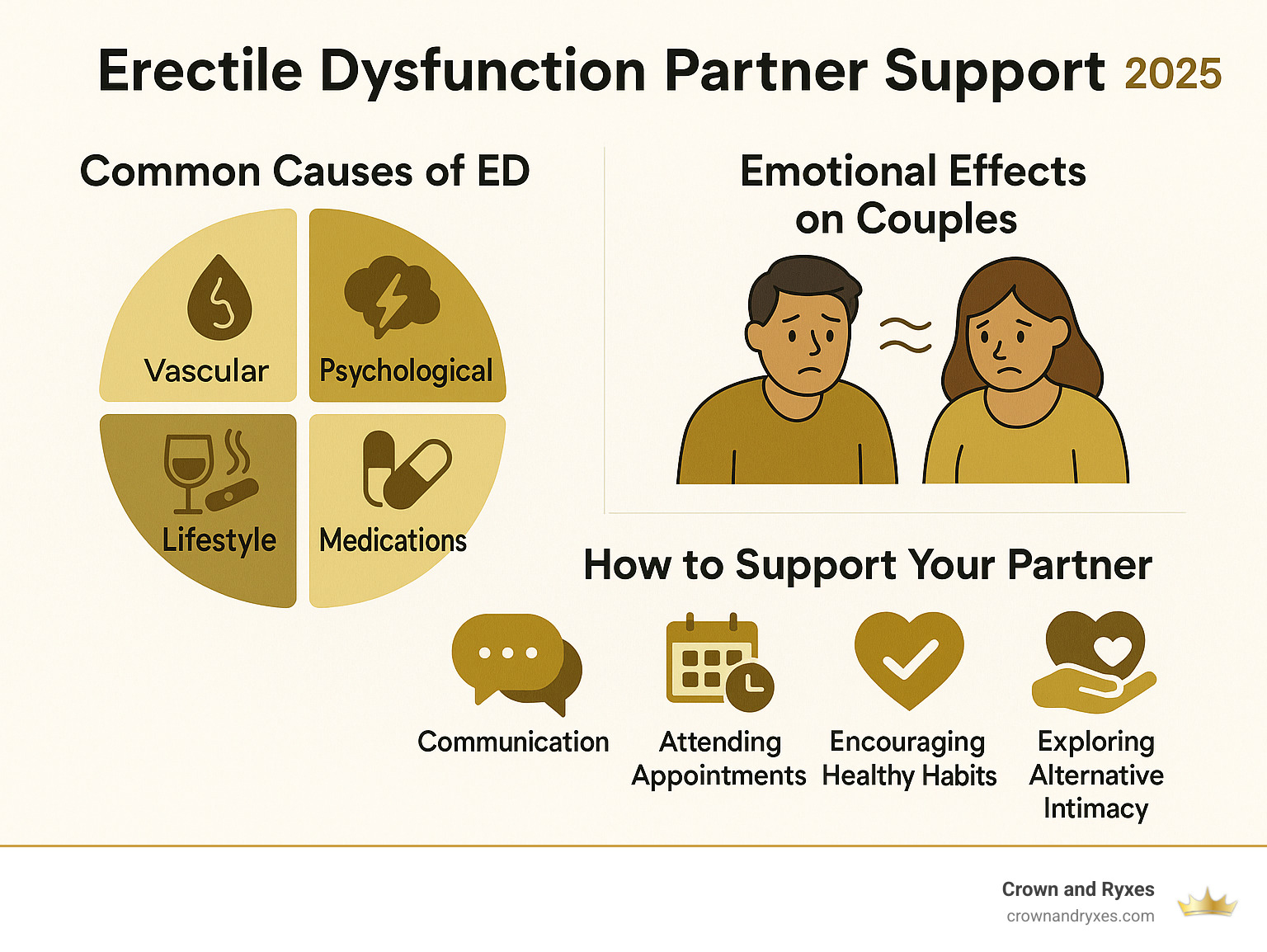
Key erectile dysfunction partner support vocabulary:
- erectile dysfunction and mental health
- erectile dysfunction lifestyle changes
- erectile dysfunction exercise benefits
Understanding Erectile Dysfunction Together
Before diving into erectile dysfunction partner support strategies, let’s understand what you’re dealing with together. Erectile dysfunction isn’t just “getting older”—it’s a real medical condition with specific causes that can often be treated effectively.
Physical factors are behind about 40% of ED cases. Poor blood flow to the penis is the most common culprit, but diabetes also plays a huge role—it actually triples a man’s risk of developing ED. Heart disease and hormonal imbalances round out the physical causes.
Here’s something that might surprise you: research shows that 80% of men who end up in the ER with their first heart attack had ED in the three years before. This makes ED an early warning sign for heart problems.
Psychological factors can be just as powerful, especially in younger men. Performance anxiety, everyday stress, depression, and relationship concerns all interfere with erections. The tricky part? Even when ED starts from physical causes, the worry about it can make everything worse.
Lifestyle factors damage the blood vessels needed for healthy erections. Smoking, heavy drinking, lack of exercise, and poor diet all contribute to ED. But here’s the encouraging news: Scientific research on exercise & ED shows that moderate to high physical activity significantly reduces ED risk.
Medications can also cause ED as a side effect. Blood pressure medications, antidepressants, and even some over-the-counter drugs can interfere with sexual function.
Age statistics show that ED becomes more common as men get older, but it’s not inevitable. About 40% of men in their 40s experience some ED, and this increases to about 70% of men in their 70s.
For more detailed information about what might be causing your partner’s ED, check out more info about causes.
Why It’s Not Your Fault
Let’s address the elephant in the room: you might be wondering if you’re somehow to blame for your partner’s ED. Maybe you’re thinking, “Am I not attractive enough?” or “Did I do something wrong?”
Stop right there. Self-blame is common among partners, but ED is almost never about partner attraction or relationship boredom. Sex therapists note that it’s rare for ED to be caused by lack of interest in one’s partner.
The attraction myths our culture promotes don’t help either. ED happens to men whose partners are incredibly attractive, newly married couples, and men in loving relationships. It’s not about how you look or what you do.
Masculinity myths create even more problems. Our culture teaches men that their worth is tied to sexual performance, which creates a vicious cycle: ED happens, shame follows, anxiety increases, and ED gets worse.
Here’s your reassurance: ED is a medical condition, just like diabetes or high blood pressure. You wouldn’t blame yourself if your partner had those conditions, would you?
Red Flags That Need Medical Attention
Sudden onset of ED, especially in younger men, can signal a serious underlying condition. Pain during erections or sex isn’t normal and needs evaluation. Curvature or bent erections could indicate Peyronie’s disease.
Cardiovascular symptoms are the most serious red flag. If ED comes with chest pain, shortness of breath, or other heart-related symptoms, this could indicate a medical emergency. Complete loss of morning erections or ED following trauma also warrant immediate medical attention.
When exploring treatment options like REGENmax or other therapies, early intervention often leads to better outcomes for both of you.
Erectile Dysfunction Partner Support: Your Roadmap at a Glance

Picture this: you and your partner are walking down a path together, just like the couple in the image above. That’s exactly what erectile dysfunction partner support should feel like—a shared journey where you’re both moving forward together, not one person dragging the other along.
The biggest shift you can make is changing your mindset from “his problem that I need to fix” to “our challenge that we’ll tackle as a team.” This isn’t about becoming a therapist or a doctor—it’s about being a loving, supportive partner who creates a safe space for healing and growth.
Empathy becomes your superpower here. Your partner is likely dealing with feelings of embarrassment, anxiety, or even shame about his masculinity. Instead of letting frustration take over (which is totally normal to feel), try to imagine how vulnerable he must be feeling.
Active listening means more than just hearing words. It’s about asking thoughtful, open-ended questions and really absorbing the answers without immediately jumping to solutions. Sometimes your partner just needs to feel heard and understood.
Timing matters more than you might think. The middle of a stressful day or right after an unsuccessful intimate moment isn’t when breakthroughs happen. Choose relaxed, private moments when you both have emotional energy to spare.
Privacy should be sacred. It might feel natural to talk through your concerns with your best friend or sister, but sharing details about your partner’s ED without permission can damage trust and make him feel even more exposed.
Starting the Conversation
When it comes to erectile dysfunction partner support, those first words you say can either open a door or slam it shut. Think of it like approaching a scared animal—you want to be gentle, non-threatening, and patient.
The bedroom is off-limits for these conversations. So is the car ride home from a disappointing evening. Instead, find a neutral space where you both feel comfortable—maybe during a quiet walk or while having coffee on a weekend morning.
Try starting with something like “I’ve noticed you seem stressed lately. Is there anything we can work on together?” This approach shows you care about his overall well-being, not just the sexual aspect. Or you might say, “I love you and want to support you. Can we talk about what’s been happening with our intimacy?”
Another gentle opener is “I’ve been reading about how common ED is. Would you like to explore some options together?” This shows you’ve done some homework and aren’t approaching this from a place of ignorance or judgment.
Open-ended questions are your friend here. Instead of “Are you okay?” (which usually gets a “fine” response), try “How are you feeling about our intimacy lately?” or “What would help you feel more comfortable talking about this?”
This might be the very first time your partner has talked about ED with anyone. Go slow, be patient, and don’t expect to solve everything in one conversation.
Managing Your Own Emotions
Here’s the part nobody warns you about: erectile dysfunction partner support can be emotionally exhausting for you too. You might feel frustrated when intimacy doesn’t work out. You might feel rejected, wondering if your partner still finds you attractive. You might even feel angry that this is happening to your relationship.
All of these feelings are completely normal and valid. Research shows that partners of men with ED often struggle with their own sexual satisfaction and may develop anxiety around intimacy. About 94% of men with ED say partner support is crucial for their recovery, but giving that support is hard when you’re struggling too.
Journaling privately can be a lifesaver. Write down your frustrations, fears, and hopes instead of dumping them on your partner in heated moments. This gives you a safe space to process your emotions without adding to his stress.
Building a support network is essential, but be careful about boundaries. Find one trusted friend, family member, or therapist who can listen to your concerns without judgment. Just remember to keep specific details private unless your partner has given permission to share.
Remember it’s not personal. ED rarely has anything to do with how attractive your partner finds you or how much he loves you. It’s usually about blood flow, anxiety, stress, or medical issues—not about you.
Focus on connection beyond sex. There are countless ways to be intimate that don’t require an erection. This journey might actually help you find new forms of closeness you never explored before.
Practical Strategies You Can Do Tonight
When ED is in the picture, you don’t have to wait for a doctor’s visit to start helping each other. Small shifts this very evening can lower pressure and boost closeness.
Extending foreplay removes the “deadline” feeling around erections. Slow things down—kissing, touching, massage—so pleasure, not performance, drives the night.
Sensate focus exercises turn attention to pure sensation. Start with non-sexual touch like a back rub; add more erotic areas only when you both feel relaxed.
Oral or manual stimulation, mutual masturbation, or a shared vibrator can give intense pleasure without needing a firm erection. Present toys as something new to find together, not a remedy for a “problem.”
Mindfulness—simply noticing breath and pleasant feelings—keeps both of you in the moment, while your partner’s pelvic-floor (Kegel) exercises build bedroom strength over time.
| Penetrative Intimacy | Non-Penetrative Intimacy |
|---|---|
| Requires firm erection | Works with any erection quality |
| Often goal-oriented | Focuses on shared pleasure |
| Higher performance pressure | Usually reduces anxiety |
| Limited techniques | Endless variety |
Lifestyle Changes You’ll Both Benefit From
- Exercise together. Even a 30-minute walk improves circulation and mood.
- Shift to a Mediterranean-style plate—veggies, fish, whole grains, olive oil.
- Set a screen-free bedtime so you both get 7-9 hours of sleep.
- Keep alcohol moderate and quit smoking together; more than any pill, these vascular fixes help erections.
For deeper tips, see our guide on erectile dysfunction lifestyle changes.
Keeping Track of Progress
A shared mood or activity log can highlight what helps most—maybe confidence rises after workouts or after trying non-penetrative play. Note even tiny wins; progress with ED is rarely linear, so celebrating small steps keeps motivation high.
When to Seek Professional & Medical Help
Sometimes love and lifestyle changes aren’t enough on their own. That’s okay—it doesn’t mean you’ve failed. About 30 million men in the United States deal with ED, and the good news is that effective treatments are available.
Urologist visits should be your first step when ED persists for more than a few months. A urologist can dig deeper to find underlying health conditions you might not know about. They’ll run tests to check hormone levels, blood flow, and other factors that affect erectile function.
Don’t wait too long to seek help. ED can be an early warning sign of heart disease, diabetes, or other serious conditions. Getting treatment early often means better outcomes for both the ED and any underlying health issues.
Counseling or sex therapy becomes especially important when stress, anxiety, or relationship concerns play a role. Even when ED has clear physical causes, the emotional impact can make things worse. A good therapist helps couples steer these challenges together.
REGENmax treatments offer an exciting option for men who want to restore natural function without relying on medications. This innovative therapy uses targeted sound waves to stimulate blood vessel growth and improve erectile function naturally.
PDE5 inhibitors like sildenafil and tadalafil are often the first medications doctors recommend. These work by improving blood flow to the penis, and they’re effective for many men. Your partner’s doctor will help determine if these are right for his situation.
Vacuum erection devices provide a non-medication approach that many couples find helpful. These devices create a vacuum that draws blood into the penis, then a ring maintains the erection.
Penile implants offer hope for men who don’t respond to other treatments. Studies show 97% patient satisfaction rates, and modern implants are more natural-feeling than ever before.
For comprehensive information about all available treatments, explore our treatment options page.
Research from the National Institute of Diabetes and Digestive and Kidney Diseases shows that partner involvement in treatment significantly improves outcomes and treatment adherence. Your support really does make a difference.
Going to Appointments Together
One of the most powerful forms of erectile dysfunction partner support is showing up—literally. Attending medical appointments together shows your partner they’re not facing this alone. Studies consistently show that men whose partners accompany them to doctor visits have better treatment outcomes.
Before the appointment, sit down together and write out your questions. What might be causing the ED? What treatment options are available? What are the side effects of recommended treatments? How long before we see results? What lifestyle changes would help most?
During the appointment, don’t be shy about taking notes or asking for clarification. Medical information can be overwhelming, and having two people listening helps ensure nothing important gets missed. Discuss medication side effects openly—knowing what to expect helps both of you feel more prepared.
After the appointment, your support becomes crucial for treatment adherence. If your partner is prescribed medication, remind them that these drugs don’t work “on command” and may take several tries to find the right dose. Some men get discouraged and stop treatment too early, but your encouragement can make all the difference.
Exploring REGENmax & Other Treatments in Clermont, FL & The Villages, FL
For couples in Clermont, FL and The Villages, FL, Crown and Ryxes offers advanced treatment options including REGENmax therapy. This low-intensity shockwave treatment represents a breakthrough in natural erectile function restoration.
REGENmax works by using targeted sound waves to promote tissue regeneration and improve blood flow naturally. The treatment stimulates your body’s own healing processes, encouraging new blood vessel growth in the penis. Many men see improvements in erectile quality, and the treatment doesn’t interfere with other medications your partner might be taking.
Success rates for REGENmax therapy are encouraging, with many patients reporting improved erections and renewed confidence. The treatment typically involves a series of sessions spread over several weeks, and your partner can usually return to normal activities immediately after each session.
Your role as a partner during REGENmax treatment includes providing emotional support throughout the treatment series, helping track improvements and any side effects, maintaining realistic expectations about the timeline, and continuing lifestyle changes that support vascular health.
Recovery varies from person to person, but many couples notice improvements in both erectile function and overall confidence within a few weeks of starting treatment. The key is patience and consistent support—your erectile dysfunction partner support remains just as important during professional treatment as it was before.
Frequently Asked Questions about Partnering Through ED
Does ED always mean a health problem?
Not always, but it’s worth taking seriously. Occasional erection difficulties are completely normal—even healthy men might struggle about 20% of the time. Life stress, fatigue, or just an off day can affect anyone’s sexual performance.
However, persistent ED usually signals something deeper. Sometimes it’s psychological factors like performance anxiety or relationship stress. Other times, it’s physical issues like poor blood flow, diabetes, or cardiovascular problems. Most often, it’s a combination of both.
Here’s what’s important to understand: ED isn’t just “normal aging.” While it becomes more common as men get older—affecting up to 50% of men over 50—it’s not something you just have to accept. Modern treatments like REGENmax and other therapies can help restore function at any age.
How can we keep intimacy if erections are unreliable?
This question opens up exciting possibilities that many couples never explore. Intimacy is so much more than penetrative sex, and finding this can actually strengthen your relationship.
Extended massage sessions can be incredibly intimate and pleasurable for both partners. Take turns giving each other full-body massages, focusing on relaxation and connection rather than sexual performance.
Mutual oral stimulation doesn’t require firm erections and can be deeply satisfying. Many couples find this becomes a favorite part of their intimate time together.
Try sensual bathing together—the warm water, soap, and unhurried touching creates a different kind of intimacy that’s both relaxing and arousing.
Exploring erogenous zones beyond genitals can be a revelation. Necks, ears, inner thighs, and other sensitive areas respond beautifully to gentle attention.
Using toys and aids thoughtfully can improve pleasure for both partners. The key is presenting them as fun additions to your intimate time, not replacements for anything “missing.”
Many couples tell us that exploring non-penetrative intimacy actually led to more satisfying sex overall. When the pressure to perform is removed, natural function often returns more easily.
What if first-line treatments don’t work?
Don’t lose hope—this is more common than you might think, and erectile dysfunction partner support becomes even more crucial during this phase. ED treatment often requires patience and trying multiple approaches before finding what works best.
If oral medications don’t provide the results you’re hoping for, there are several next steps to consider. Adjusting medication dosage or timing sometimes makes all the difference. Some men find that taking medication on an empty stomach works better, or that a different dosage is more effective.
Trying different medication classes can be helpful since not all ED medications work the same way for every man. What doesn’t work for one person might be perfect for another.
Combining treatments often provides better results than using just one approach. This might mean medication plus therapy, or REGENmax treatment combined with lifestyle changes.
Exploring REGENmax or other advanced therapies opens up cutting-edge options that many men haven’t tried yet. REGENmax uses low-intensity shockwave therapy to improve blood flow naturally and can be particularly effective for men who haven’t responded to medications.
Considering vacuum devices or injection therapies provides mechanical solutions that work differently than oral medications. While these might sound intimidating, many couples find them helpful once they get used to the process.
The most important thing is working with healthcare providers who specialize in sexual health and won’t give up on finding solutions. At Crown and Ryxes, we’ve helped many couples steer this journey, and we’ve seen that persistence usually pays off.
Conclusion

Supporting a partner through erectile dysfunction isn’t about becoming a medical expert or fixing everything yourself. It’s about showing up consistently with patience, understanding, and love—even when the road gets bumpy.
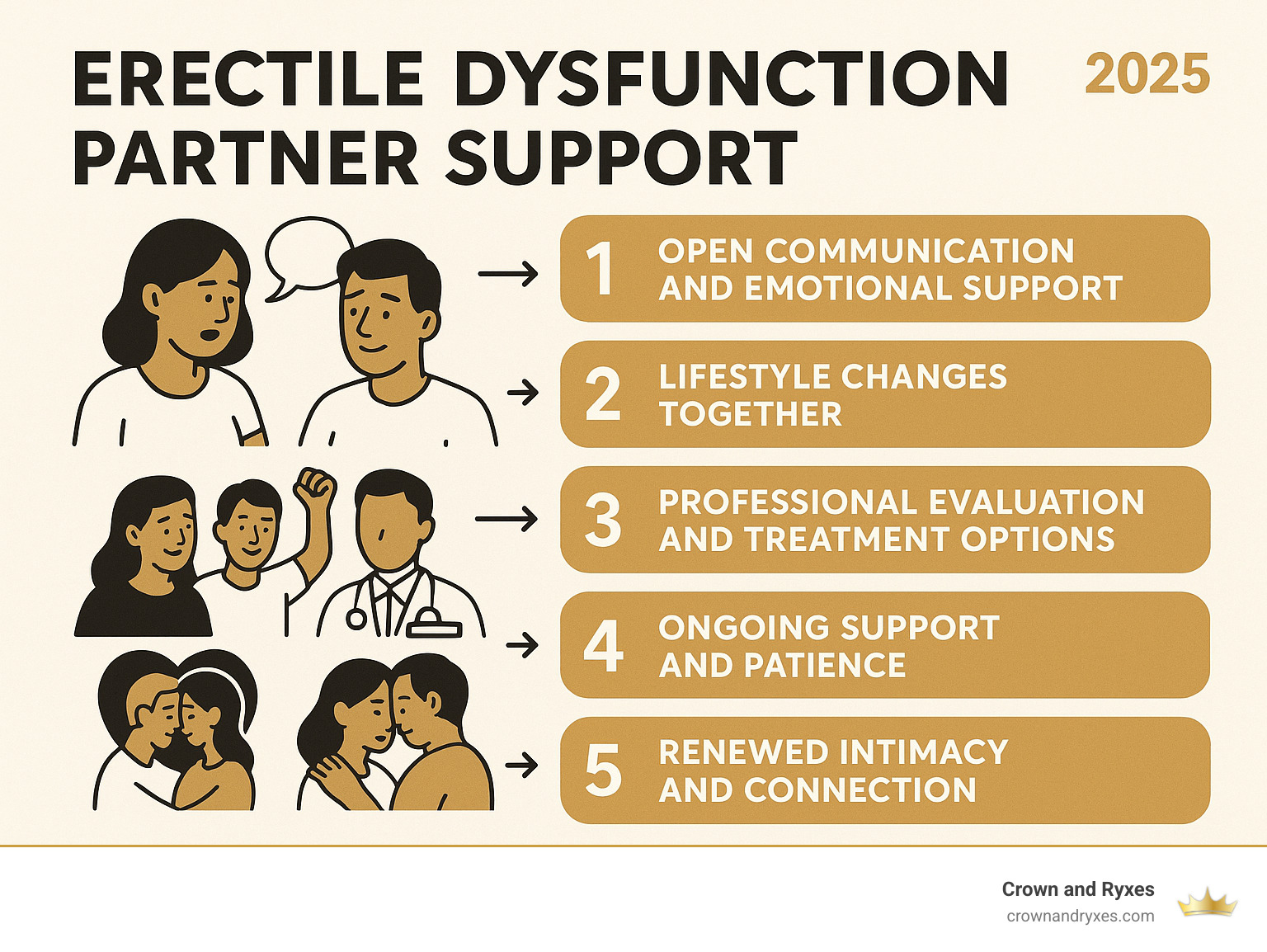
Throughout this guide, we’ve explored how erectile dysfunction partner support transforms what could be a lonely struggle into a shared journey. The couples who thrive through ED are the ones who communicate openly, make lifestyle changes together, and seek professional help when needed.
Here’s what I’ve learned from years of helping couples steer ED: the relationships that emerge from this challenge are often stronger and more intimate than before. When you learn to connect beyond traditional sexual expectations, you find new depths of intimacy that many couples never experience.
The path forward isn’t always smooth, but it’s surprisingly hopeful. Open communication breaks down the walls that shame and embarrassment build. Lifestyle changes benefit both partners and show true solidarity. Professional treatments like REGENmax offer real solutions that can restore confidence and function. Most importantly, patience and creativity help you find that intimacy has countless expressions.
Setbacks are normal. Some days will feel like progress, others might feel discouraging. The key is maintaining perspective and celebrating small victories along the way.
If you’re in Clermont, FL or The Villages, FL and ready to explore comprehensive treatment options, Crown and Ryxes understands that ED affects both partners. Our approach includes REGENmax therapy and other advanced treatments, always with the recognition that healing happens best when couples work together.
For more information about our complete approach to men’s sexual health and wellness, visit our sexual wellness services page.
You don’t have to steer this alone. With the right support, professional guidance, and commitment to each other, most couples find their way back to satisfying intimacy. Often, they find their relationship is more resilient and connected than they ever imagined possible.