

Understanding the Success Behind Modern Hair Restoration
The hair transplant failure rate is a critical concern for anyone considering this life-changing procedure. Here’s what you need to know:
Quick Answer: Hair Transplant Failure Rates
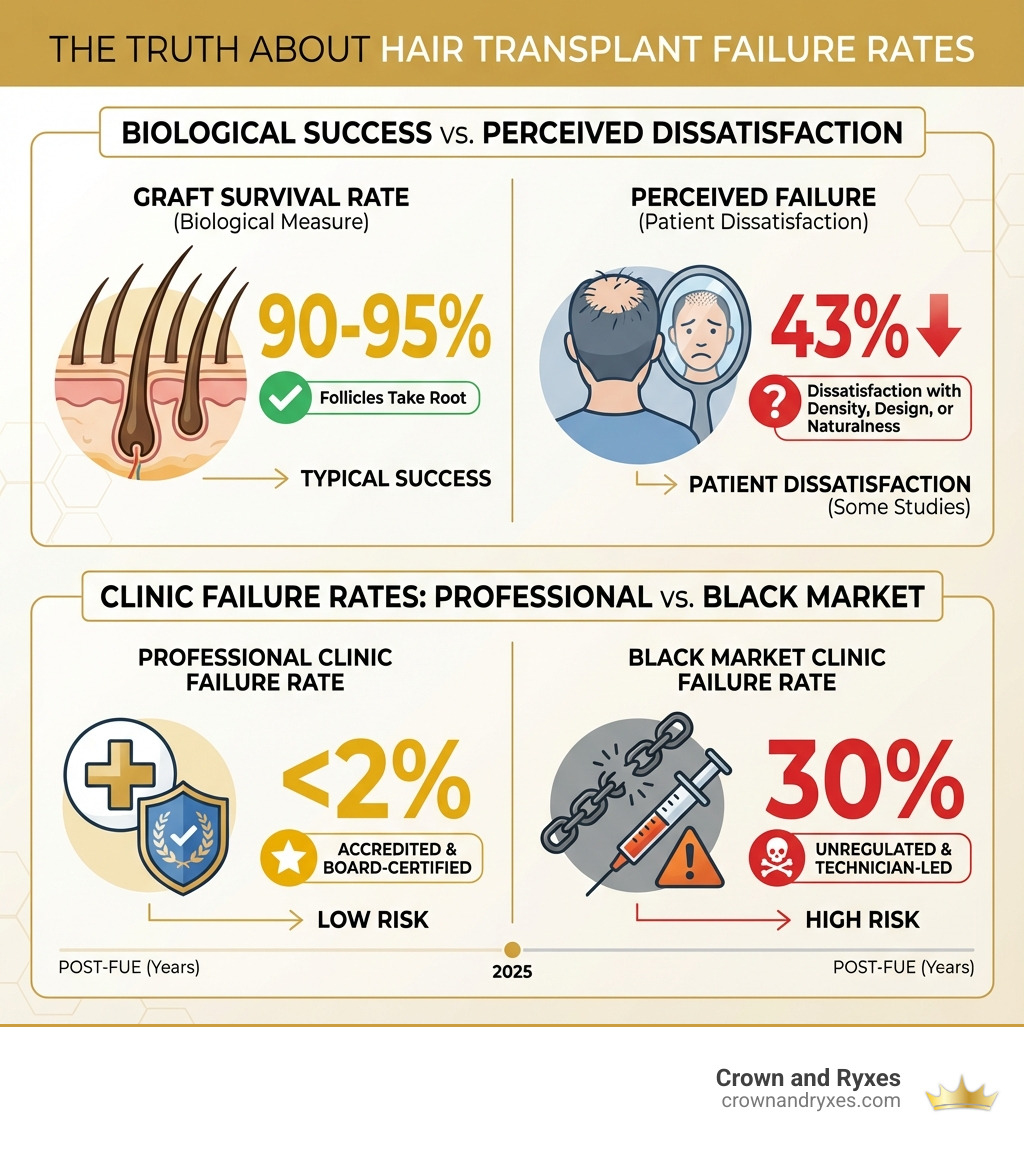
- Overall Success Rate: 90-95% graft survival at reputable clinics
- Professional Clinics: Less than 2% failure rate
- Unprofessional/Black Market Clinics: Up to 30% failure rate
- Patient Satisfaction: Average 8.3 out of 10 (3 years post-FUE)
- General Failure Range: 5-10% possibility across all clinics
Hair transplantation has evolved dramatically from the obvious “hair plugs” of the 1980s. Today’s advanced techniques—Follicular Unit Extraction (FUE) and Follicular Unit Transplantation (FUT)—deliver natural-looking results that even hair stylists can’t detect.
What defines a “failed” hair transplant? It’s not just about graft survival. True success means:
- Natural-looking hairline and growth pattern
- Adequate density in the recipient area
- Minimal visible scarring in the donor area
- Patient satisfaction with the aesthetic result
The reality is encouraging: hair transplants performed by experienced surgeons have exceptionally high success rates. However, failure can still occur, and understanding why is essential before committing to the procedure.
Outcomes are influenced by surgeon expertise, graft handling, patient health, and post-operative care. The hair transplant failure rate varies dramatically between clinics. “Black market” or technician-led operations can have failure rates as high as 30%, while board-certified surgeons at accredited facilities maintain rates below 2%.
What is the Real Hair Transplant Failure Rate?
Understanding the hair transplant failure rate requires defining “failure.” Medically, a transplant is successful if 80% or more of the transplanted follicles survive and grow. Modern surgery boasts a high success rate, with graft survival typically between 90-95% at reputable clinics. This means the vast majority of moved follicles will take root and grow.
Patient satisfaction is another key metric. A 2016 study on FUE patients found an average satisfaction rating of 8.3 out of 10 three years post-treatment, attesting to the positive outcomes. You can learn more about patient satisfaction in FUE procedures in this scientific research on FUE patient satisfaction.
However, it’s important to differentiate between graft survival and “perceived failure.” An ISHRS (International Society of Hair Restoration Surgery) study noted that patient-reported failure could be around 43%. This often reflects unrealistic expectations or dissatisfaction with aesthetics (like density or hairline design), not a total loss of grafts.
What is the typical hair transplant failure rate?
Despite high graft survival, a low hair transplant failure rate is still possible. With modern methods, the general failure percentage is around 5-10%. This figure varies significantly based on the clinic.
At professional, accredited clinics with skilled surgeons, the true failure rate (poor graft survival) is less than 2%. This reflects meticulous technique, advanced equipment, and comprehensive post-operative care.
Conversely, at unprofessional or “black market” clinics, the hair transplant failure rate can be as high as 30%. These clinics often lack experienced surgeons, sterile environments, or proper support, leading to poor outcomes. This highlights the importance of choosing your clinic wisely.
Signs of a Failed Hair Transplant
Identifying a failed transplant early is crucial. Here are key signs of an unsuccessful procedure:
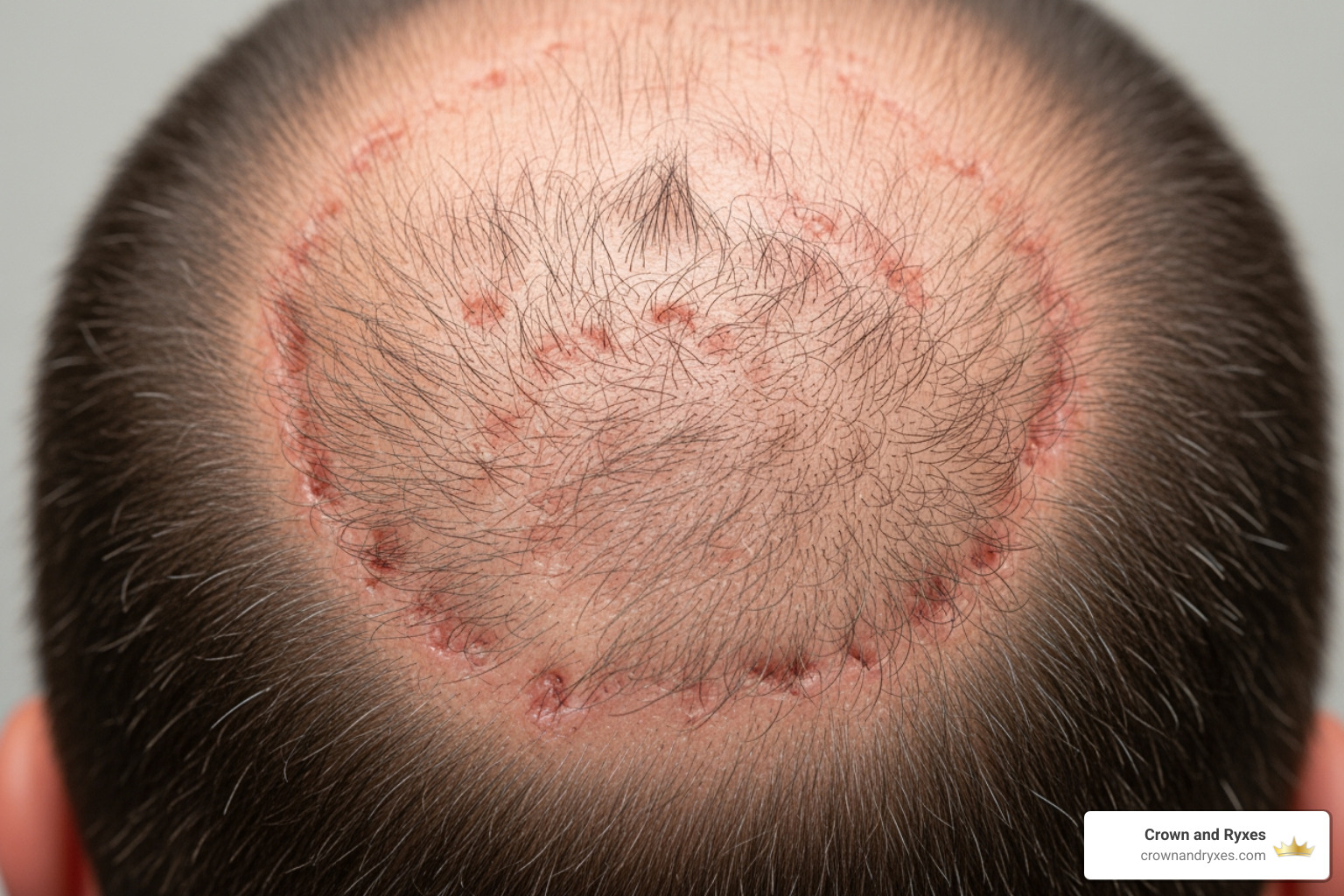
- Low Density or Sparse Growth: The transplanted area remains thin or looks significantly less dense than expected, sometimes with a “moth-eaten” appearance.
- Unnatural Hairline: The hairline is too straight, too low, or lacks natural irregularity. Incorrect hair angle and direction also create an unnatural look.
- Patchy Growth: Hair growth is uneven, with some areas growing hair while others remain sparse or bald.
- Excessive Scarring: Prominent scarring in the donor area, such as a wide linear scar from FUT or highly visible white dots from FUE, indicates poor technique.
- No Growth After 12-18 Months: Little to no new hair appears in the transplanted area after a year to 18 months, indicating graft survival failure.
- Cobblestoning: The scalp in the recipient area has a bumpy, uneven texture due to improper graft placement.
- Inflammatory Complications: Persistent inflammation, folliculitis, infection, or tissue necrosis can signal a failed transplant.
Why Do Hair Transplants Fail? Key Contributing Factors
The success of a hair transplant hinges on many factors. Understanding these can help prevent a high hair transplant failure rate. From the surgeon’s skill to patient adherence to post-op care, every step is vital.
How Inexperience Inflates the Hair Transplant Failure Rate
The surgeon’s skill is the most critical factor. An inexperienced surgeon increases the hair transplant failure rate through several missteps:
- Poor Hairline Design: An inexperienced surgeon may create a hairline that is too straight, low, or symmetrical, making it look unnatural.
- Overharvesting Donor Area: Aggressive extraction can leave the donor area looking sparse or “moth-eaten,” compromising future procedures and aesthetics.
- Incorrect Graft Angle and Direction: Improper angulation results in an unnatural, “pluggy” look where hairs grow in an inconsistent manner.
- Damage to Existing Hair: Inexperienced hands can damage native hair follicles, leading to “shock loss” that can thin out surrounding areas.
The Critical Role of Graft Handling and Technique
Improper handling of delicate hair grafts can lead to a high hair transplant failure rate. Hair follicles are living tissues requiring meticulous care:
- Graft Damage: Fragile follicular units can be damaged during extraction (transection), dissection, or implantation, which prevents successful growth.
- Dehydration: Grafts left out of the body too long without proper hydration in a controlled-temperature solution will not survive.
- Improper Storage Solutions: Using suboptimal holding mediums instead of specialized solutions like HypoThermosol® with ATP significantly reduces graft survival. For more on this, see this review of factors affecting graft survival.
- Recipient Site Creation: The size, depth, and density of recipient sites must be precise to avoid poor graft survival, cobblestoning, or an unnatural look.
Patient-Related Factors and Unrealistic Expectations
Patient-related factors also contribute to the hair transplant failure rate:
- Poor Candidacy: Not everyone is a good candidate. Insufficient donor hair, unstable hair loss, or certain medical conditions can make success difficult.
- Unmanaged Hair Loss: A transplant only addresses current balding. If progressive hair loss isn’t managed with medication, native hair loss can continue around the transplant, creating a poor result.
- Unrealistic Expectations: Patients expecting to regain their youthful hairline may be dissatisfied even with a technically successful procedure. Open communication with your surgeon in Clermont, FL, or The Villages, FL, is vital to align expectations with achievable results.
- Poor Scalp Health: An unhealthy scalp with inflammation, severe dandruff, or poor circulation can hinder graft survival.
- Underlying Conditions: Dermatological conditions like Lichen Planopilaris (LLP) can destroy hair follicles and must be managed before a transplant.
- Lifestyle Factors: Smoking and excessive alcohol impair circulation crucial for healing. We strongly advise patients in Clermont, FL, and The Villages, FL, to avoid these habits before and after their procedure.
- Post-Operative Care Non-Compliance: Failing to follow post-op instructions (e.g., not scratching, avoiding strenuous activity) can dislodge grafts or cause infection, increasing the hair transplant failure rate.
FUE vs. FUT: A Look at Success Rates and Potential for Failure
FUE and FUT are both highly effective hair transplant methods with excellent success rates. The best choice depends on the patient’s hair loss pattern, goals, and donor area characteristics.
Follicular Unit Extraction (FUE)
FUE involves extracting individual follicular units with a small punch tool, leaving tiny, often imperceptible scars.
- Success Rates: When performed by experts, FUE has high graft survival rates of 90-95%, similar to FUT.
- Potential for Failure: Risks include:
- Overharvesting: Can deplete the donor area, causing a thin or “moth-eaten” look.
- Transection: Inexperienced technique can damage follicles during extraction, especially with curly hair.
- Pinpoint Scarring: Numerous tiny white dots can become visible with very short hairstyles.
- Prolonged Out-of-Body Time: Lengthy extraction times increase the risk of graft dehydration if not managed well.
Follicular Unit Transplantation (FUT)
FUT involves removing a linear strip of scalp, dissecting it into follicular units, and closing the incision, which leaves a linear scar.
- Success Rates: FUT also has excellent graft survival rates (90-95%) and can yield a high number of grafts in one session.
- Potential for Failure: Risks include:
- Linear Scarring: The main drawback is a linear scar, which can become wide and visible if not closed properly. Special closure techniques can minimize its appearance.
- Nerve Damage/Numbness: Nerve transection during strip removal can cause temporary or, rarely, permanent numbness.
- Donor Hair Effluvium (Shock Loss): Temporary shedding of surrounding native hair due to surgical trauma.
- Infection/Dehiscence: A small risk of infection or wound opening if post-op care is not followed.
Here’s a comparison table summarizing FUE and FUT:
| Feature | Follicular Unit Extraction (FUE) | Follicular Unit Transplantation (FUT) |
|---|---|---|
| Extraction | Individual follicular units extracted directly | Linear strip of scalp removed, then dissected into units |
| Scarring | Tiny, punctate scars (less noticeable, but can be numerous) | Linear scar (can be wide if not done well) |
| Donor Area | Wider area harvested, potential for diffuse thinning if overharvested | Smaller, concentrated area harvested, typically preserves overall density |
| Recovery | Quicker healing in donor area, less discomfort | Longer healing for donor incision, more initial discomfort |
| Hair Style | Can wear hair very short | Requires longer hair to cover linear scar |
| Graft Yield | Potentially fewer grafts per session (depends on technique) | Can yield larger number of grafts in a single session |
| Cost | Often slightly higher per graft due to labor intensity | Often slightly lower per graft |
| Candidacy | Good for those who wear short hair, prefer no linear scar | Good for larger balding areas, maximizing grafts, good scalp laxity |
| Failure Risks | Overharvesting, transection, pinpoint scars | Wide linear scar, nerve damage, infection |
Can a Failed Hair Transplant Be Corrected?
The good news is that a failed or unsatisfactory hair transplant can often be corrected. A disappointing outcome can be distressing, and our team in Clermont, FL, and The Villages, FL, is here to explore solutions with you.
- Revision Surgery: A second procedure can add density, refine the hairline, or fill in patchy areas, depending on donor hair availability.
- Scar Repair: FUT scars can be revised or camouflaged with FUE grafts. FUE pinpoint scars can be concealed with scalp micropigmentation (SMP).
- Adding Density: If the initial transplant lacked density, additional sessions can strategically place more grafts for a fuller look, pending donor supply.
- Correcting the Hairline: An unnatural hairline can be revised by removing and re-transplanting misplaced grafts or by adding new grafts to soften the line.
- Body Hair Transplants (BHT): If scalp donor hair is depleted, hair from the beard or chest can sometimes be used to increase density.
- Scalp Micropigmentation (SMP): This non-surgical technique tattoos tiny dots on the scalp to mimic hair follicles, effectively camouflaging scars or creating an illusion of density.
Consulting an experienced hair restoration specialist is essential to assess the issue and determine the best corrective strategy.
How to Ensure a Successful Outcome
While the hair transplant failure rate is low at reputable clinics, success requires a partnership between you and your medical team. Your active participation is as important as the surgeon’s skill.
Choosing the Right Clinic to Minimize Your Risk
Selecting the right clinic is the most important decision to minimize your hair transplant failure rate. Look for these criteria:
- Surgeon Credentials: Ensure your surgeon is board-certified with experience in hair restoration. Membership in organizations like the International Society of Hair Restoration Surgery (ISHRS) indicates a commitment to high standards.
- Before-and-After Photos: Review the clinic’s portfolio for natural-looking results in cases similar to yours.
- In-Person Consultation: A thorough consultation is crucial for assessing your hair loss, donor area, and goals. Be wary of clinics that rush this process.
- Transparent Pricing: Understand all costs upfront. Be cautious of “too good to be true” offers, which often come from “black market” clinics with high failure rates.
- Staff Experience: Inquire about the experience of the medical team, especially the technicians handling the grafts and those familiar with your hair type.
- Accreditation and Regulation: Choose a clinic that adheres to high medical standards and operates in a clean, professional environment. Inquire about their safety protocols.
The Importance of Patient Selection and Medications
Proper patient selection and following medical advice are key to long-term success:
- Proper Diagnosis: A correct diagnosis, usually androgenetic alopecia, guides the treatment plan.
- Donor Hair Density and Scalp Laxity: These factors determine how many grafts can be safely harvested.
- Age: Many surgeons recommend waiting until at least 22-25 years old for the hair loss pattern to stabilize, preventing an unnatural look later.
- Impact of Minoxidil and Finasteride on Longevity: These medications are crucial for managing progressive hair loss of native (non-transplanted) hair. While a study found no significant impact on the longevity of transplanted hair, these drugs help maintain overall density by preventing further native hair loss and strengthening existing hair, enhancing the final aesthetic result.
Frequently Asked Questions about Hair Transplant Longevity
Here are answers to common questions about the long-term outlook after a hair transplant.
How long does it take to see the final results of a hair transplant?
Patience is key, as results appear gradually:
- Shock Loss (2-6 weeks): Newly transplanted hairs shed. This is a normal resting phase before regrowth.
- Initial Growth (3-4 months): New, fine hairs begin to emerge, though growth is still sparse.
- Significant Growth (6-9 months): Hair becomes noticeably thicker and longer, improving density.
- Final Results (12-18 months): The final, mature results are typically visible at this point, with full density and naturalness. Minor improvements can continue for up to 24 months.
What is the longevity of transplanted hair follicles?
Transplanted hair follicles are generally considered permanent.
- Permanent Nature: Follicles are harvested from the DHT-resistant “safe donor zone” at the back and sides of the head. They retain this genetic resistance and will grow for life in their new location, a principle known as donor dominance.
- Future Hair Loss of Non-Transplanted Hair: While transplanted hair is permanent, your native hair may still be susceptible to balding. Medications like finasteride or minoxidil are often used to protect existing hair.
- Study on Longevity: A study on the longevity of transplanted follicles showed that while most patients had good long-term results, some experienced a moderate reduction in density over 4 years. This suggests that while follicles survive, other factors can slightly decrease perceived density over time, but complete loss is rare.
Can hair grafts be rejected by the body?
No, your body will not reject the hair grafts in the typical sense.
- Autograft Procedure: A hair transplant is an autograft, using your own tissue. Therefore, your immune system will not recognize the grafts as foreign and reject them.
- Infection vs. Rejection: What may seem like “rejection” is usually a complication like infection or poor graft survival due to other factors.
- Underlying Inflammatory Scalp Conditions: In rare cases, inflammatory scalp conditions like Lichen Planopilaris (LLP) can attack hair follicles (including transplanted ones). Proper screening before your procedure at our Clermont, FL, or The Villages, FL, clinic can help identify such conditions.
Conclusion
The reality of the hair transplant failure rate is overwhelmingly positive. Modern procedures performed by skilled professionals have success rates of 90-95% graft survival. While failure is possible, it is largely preventable and often correctable.
A successful outcome depends on choosing an experienced, board-certified surgeon and an accredited clinic like Crown and Ryxes, having realistic expectations, and following all care instructions. Your role as a patient is crucial to success.
We are dedicated to providing personalized care and advanced hair restoration solutions for both men and women in Clermont, FL, and The Villages, FL. Whether you’re considering a transplant, exploring non-surgical options, or seeking REGENmax, our team is here to guide you. Take control of your hair restoration journey and let us help you achieve the natural, confident look you deserve.