

Understanding the Male Eyebrow Transplant Revolution
A male eyebrow transplant is changing how men approach facial aesthetics and confidence. This minimally invasive procedure uses your own hair follicles to restore thinning or sparse eyebrows, creating natural-looking results that improve masculine facial features.
Key Facts About Male Eyebrow Transplants:
- Procedure time: 4-6 hours as an outpatient procedure
- Grafts needed: 200-400 grafts per eyebrow for natural density
- Recovery: Initial healing in 7-10 days, full results in 9-12 months
- Success rate: 97-100% when performed by skilled surgeons
- Permanency: Results last a lifetime with proper care
Eyebrows play a crucial role in facial expression and masculine identity. For many men, thinning brows due to aging, genetics, or over-grooming can significantly impact self-confidence. Unlike temporary solutions like makeup or microblading, an eyebrow transplant offers a permanent solution that grows naturally with your facial hair.
The procedure has gained remarkable popularity as more men recognize the importance of well-defined brows in creating facial symmetry and a youthful appearance. Men’s eyebrows are characteristically straighter than women’s, lacking the high arch, and require precise implantation to maintain this masculine aesthetic.
I’m Dr. Matthew Casavant, and with over 20 years of experience in advanced minimally invasive surgery, I’ve helped countless patients achieve natural-looking results through meticulous surgical techniques. My expertise in male eyebrow transplant procedures focuses on creating the ideal masculine brow shape while ensuring optimal healing and long-term satisfaction.

Why Men Choose Eyebrow Transplants
Your eyebrows do more than frame your eyes—they’re a cornerstone of masculine facial identity. When you raise an eyebrow in surprise or furrow your brow in concentration, these expressive features communicate who you are before you even speak. For many men, well-defined brows create the facial symmetry and strong presence that makes them feel confident in their own skin.
The psychology behind eyebrow restoration runs deeper than simple vanity. When your brows start thinning or become patchy, it can feel like losing part of your identity. Many of our patients tell us they avoided close-up photos or felt self-conscious in professional settings. A male eyebrow transplant doesn’t just restore hair—it restores the confidence that comes with looking like yourself again.
Unlike women who might feel comfortable using makeup to fill sparse areas, most men prefer a permanent solution. The idea of daily eyebrow pencils or frequent microblading touch-ups simply doesn’t fit their lifestyle. That’s where transplantation shines as a one-time investment in your appearance that grows naturally with your other facial hair.
The psychological benefits extend far beyond the mirror. Men often report feeling more youthful and energetic after their procedure. There’s something powerful about having that strong brow line that frames your eyes and gives your face the definition it once had.
Common Causes of Eyebrow Thinning
Eyebrow hair loss, medically called madarosis, affects men for various reasons. Understanding what’s causing your thinning brows helps determine whether a male eyebrow transplant is your best option.
Genetics plays the biggest role in most cases. Just like some men inherit male pattern baldness, others inherit sparse or thinning eyebrows. If your father or grandfather had thin brows, you might be following the same pattern. The aging process naturally slows down hair follicle activity too, which is why many men notice their brows becoming less dense as they get older.
Over-grooming creates another common problem. Years of aggressive plucking or tweezing can damage hair follicles permanently, leading to what doctors call traction alopecia. Some men who over-trimmed their brows in their younger years find the hair never quite grows back the same way.
Several medical conditions can also impact eyebrow growth. Thyroid imbalances frequently cause hair thinning, especially in the outer portions of the eyebrows. Whether you have an overactive or underactive thyroid, your brow hair often pays the price. Autoimmune disorders like alopecia areata can create patchy hair loss anywhere on your body, including your eyebrows.
Scars from trauma or burns leave permanent marks where hair simply cannot grow. Whether from childhood accidents, sports injuries, or surgical procedures, these areas require transplanted follicles to restore natural coverage.
For men dealing with broader hair loss patterns, our comprehensive approach addresses multiple areas. You can find more information about Male Pattern Baldness Treatment to understand how we tackle hair restoration holistically.
Defining the Ideal Masculine Brow
Men’s eyebrows should look distinctly different from women’s, and getting this right makes all the difference in your final results. The masculine brow follows a straighter shape without the high arch that looks feminine. Think of it as a subtle, confident line that follows your natural bone structure rather than creating dramatic curves.

The ideal masculine brow maintains desired thickness and density throughout its length, typically measuring about 5 to 6 centimeters long and 1 to 1.5 centimeters wide. We divide each eyebrow into three distinct sections during our planning process.
The head of your eyebrow—the inner portion closest to your nose—makes up about 10-15% of the total length. This area should have good density but not look overly thick. The body forms the central 60% and typically appears the fullest and most defined. Finally, the tail extends toward your temple, comprising the remaining 20-25% with a natural taper.
Our custom design process begins long before any hair is transplanted. We carefully assess your facial bone structure, existing hair patterns, and personal goals. Every man’s face is unique, so we draw the proposed brow shape directly on your skin and get your approval before proceeding. This ensures your new eyebrows will improve your natural masculine features rather than looking artificial or out of place.
The key difference from female brow design is maintaining that straighter line with minimal arching. If there’s any peak to the brow, it sits closer to the center rather than creating the dramatic lateral arch that works for women. This subtle distinction makes your results look naturally masculine and completely authentic.
The Male Eyebrow Transplant Procedure Explained
When you’re ready to transform your eyebrows, you’ll be pleased to know that a male eyebrow transplant is surprisingly straightforward. This sophisticated yet minimally invasive procedure uses the proven Follicular Unit Excision (FUE) method, which has revolutionized hair restoration by allowing us to harvest and place individual hair follicles with incredible precision.
The entire procedure happens right in our clinic as an outpatient service. You’ll be comfortable throughout thanks to local anesthesia, and you can go home the same day. Most men are surprised by how relaxed the experience actually is – many even catch up on podcasts or chat with our team during the procedure.
If you’re curious about the technical details behind FUE restoration, our comprehensive guide covers everything: A Practical Guide to FUE Hair Restoration Procedure Details.
Step 1: Consultation and Custom Design
Your male eyebrow transplant journey starts with what many patients tell us is their favorite part – designing your new look. This isn’t a one-size-fits-all approach. Every man’s face is unique, and your eyebrows should reflect that individuality while enhancing your natural masculine features.
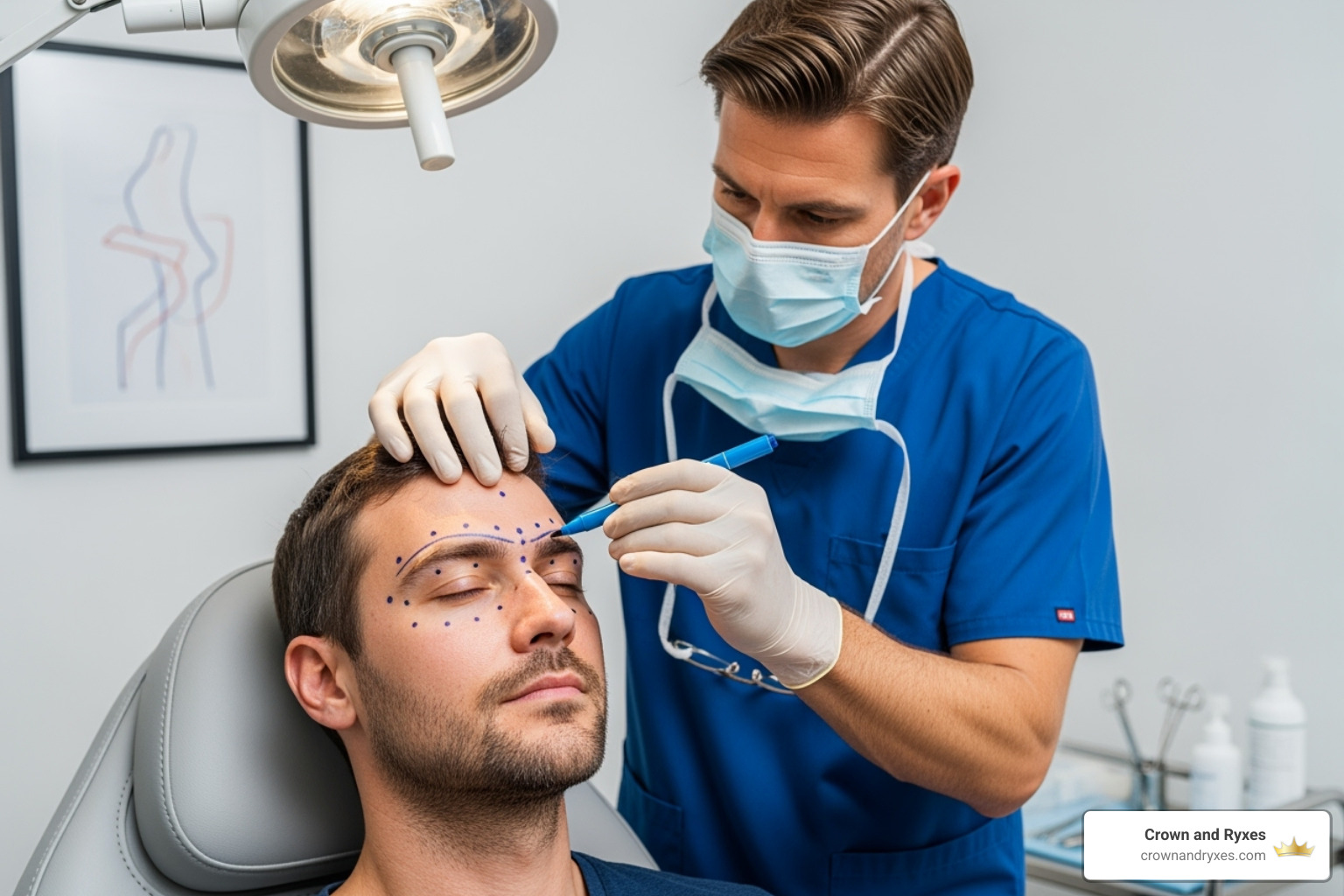
During our consultation, we dive deep into understanding you. We carefully assess your facial features, looking at your bone structure, natural facial symmetry, and what’s left of your existing eyebrows. This helps us create a design that looks like it was always meant to be there.
We love when patients bring photos – maybe pictures of yourself from younger years or even examples of eyebrow styles you admire. Discussing your goals openly helps us understand exactly what you’re hoping to achieve. Some men want subtle improvement, while others are looking for a more dramatic change.
The donor hair evaluation is fascinating for most patients. We examine your scalp, typically focusing on the back and sides of your head where the hair is genetically programmed to keep growing strong. This hair from your occipital or midparietal scalp area matches perfectly with what eyebrows should look like naturally. Sometimes we might consider finer hair from the nape of your neck for an even more delicate appearance.
Once we’ve gathered all this information, the magic happens. We plan the exact shape and density for your new eyebrows, then draw the final outline directly on your face. You get to see exactly how you’ll look and approve every detail before we proceed. It’s collaborative – after all, you’re the one who’ll be looking in the mirror every day.
Step 2: Graft Harvesting and Implantation
Now comes the artistry combined with surgical precision. This phase requires both technical skill and an artistic eye to create results that look completely natural.
We start by preparing the donor area at the back of your scalp. Here’s something you’ll appreciate – we often use unshaven FUE techniques, which means we don’t need to buzz off large sections of your hair. You can return to work and social activities without obvious signs of having had a procedure.
Under local anesthesia, we carefully extract individual hair follicles using specialized micro-punches, typically just 0.7 to 0.9 millimeters in diameter. These tiny instruments leave virtually no scarring and heal quickly. Each follicle is harvested with extreme care to preserve its integrity.
The harvested follicles are then prepared under magnification – this step is crucial for their survival. Meanwhile, we create recipient sites in your eyebrow area, following that custom design we created together. This is where the real artistry begins.
Meticulous graft placement is what separates excellent results from mediocre ones. Each hair follicle must be placed at precisely the right angle and direction. Natural eyebrow hairs grow almost flat against the skin at sharp angles – quite different from scalp hair. We replicate this by placing hairs to grow upward in the inner portion, outward and slightly downward in the body, and horizontally in the tail, often creating a natural crisscross pattern.
The angulation and direction of each individual hair matters enormously. Get it wrong, and the eyebrows look obviously transplanted. Get it right, and even hair stylists won’t be able to tell the difference.
This meticulous attention to detail is backed by extensive research. The scientific community has documented these techniques thoroughly, as detailed in The Science and Art of Eyebrow Transplantation by Follicular Unit Extraction. Our expertise in these advanced FUE techniques has helped countless men achieve natural-looking results – you can learn more about our approach at FUE Hair Restoration.
Recovery, Results, and Long-Term Care
Your journey doesn’t end when you leave our clinic after your male eyebrow transplant. In fact, the most exciting part is just beginning. Over the coming months, you’ll watch as your new eyebrows gradually develop into the natural, masculine look you’ve been hoping for.

The first thing to understand is that healing is a process, not an event. Right after your procedure, you’ll notice some redness and mild swelling around your eyes and brows. Don’t worry – this is completely normal and shows that your body is responding properly to the treatment. You might also see tiny scabs forming over each transplanted follicle, which is exactly what we want to see.
Here’s something that surprises many of our patients: within the first few weeks, some of the transplanted hairs will actually fall out. This might seem alarming, but it’s actually a great sign. This “shock loss” is nature’s way of making room for stronger, permanent hair to grow. Think of it like a tree shedding its leaves before spring – it’s preparing for something better.
The full change takes time. New hair growth typically appears between 3 to 6 months, and you’ll see your final results around 9 to 12 months after your procedure. It’s worth the wait – these results will last a lifetime.
For more detailed information about what to expect during recovery, check out The Recovery Process: What to Expect After a Hair Transplant.
The Recovery Timeline
Understanding what happens when can help ease any concerns and keep you on track for the best possible results.
During the first 24 to 48 hours, you might experience mild swelling and redness around your eyes and brows. We recommend applying cold compresses (not directly on the grafts) and sleeping with your head slightly liftd. The most important rule during this time is simple: don’t touch the transplanted area.
Throughout the first week, those tiny scabs we mentioned will form and gradually fall off on their own. After four days, you can begin gentle cleaning with the saline solution we provide. The key word here is gentle – think dabbing, not rubbing. Your donor area will also start healing during this time.
Between 2 to 4 weeks, you’ll experience the shedding phase. The transplanted hairs will fall out, but remember – this is completely normal and necessary. Your follicles are entering a resting phase before they start producing new, permanent hair.
From 3 to 6 months, the magic really begins. New hair growth starts appearing, though it may look fine or sparse at first. These hairs will gradually thicken and become more robust. By six months, you’ll typically see about 50 to 60% of your new hair growth.
At 12 months, you’ll see the final results of your male eyebrow transplant. The transplanted hairs will have fully grown in, giving you that natural, fuller eyebrow appearance you’ve been waiting for. Most patients see 70 to 90% of their transplanted hairs growing successfully.
Maintaining Your New Eyebrows
Here’s something that might surprise you: your transplanted eyebrow hairs will retain the characteristics of scalp hair. This means they’ll keep growing just like the hair on your head. While this might sound like extra work, it’s actually a good thing – it means your results are truly permanent.
Regular trimming becomes part of your routine, typically once a week or every two to three weeks, depending on how fast your hair grows. Think of it as a small trade-off for never having to worry about sparse brows again. Many of our patients actually enjoy this aspect – it gives them control over their exact look.
You can groom and style your new eyebrows however you like. Some men find that a little eyebrow wax or gel helps keep everything in place and maintains that sharp, masculine shape. We’ll provide you with specific grooming tips and aftercare instructions to help you get the most out of your new look.
The best part? These eyebrows are truly yours. They’ll respond to your body’s natural cycles, grow with you as you age, and become a permanent part of your appearance. No more temporary fixes or daily maintenance routines.
To see the incredible changes our patients experience, visit Hair Transplant Before and After: A Guide to the Change and witness the confidence that comes with natural-looking, permanent results.
Important Considerations for a Male Eyebrow Transplant
Before you decide on a male eyebrow transplant, it’s important to understand all aspects of this life-changing decision. I believe in giving you complete transparency so you can make the choice that’s right for you.
Not everyone is an ideal candidate for this procedure. We look for several key factors during your assessment: the underlying cause of your eyebrow hair loss, the quality and availability of healthy donor hair (usually from your scalp), and your overall health status. The best candidates typically have stable hair loss patterns – meaning we want to avoid situations where active conditions like Alopecia Areata might affect your results. Most importantly, we need you to have realistic expectations about what the procedure can achieve.
The investment in a male eyebrow transplant varies significantly based on your individual needs. Factors like the number of grafts required, the complexity of your case, and the surgeon’s expertise all influence the final cost. In the US, you can generally expect to invest between $3,000 and $6,000 for this procedure. While this might seem substantial, many of our patients tell us it’s one of the best investments they’ve made in their confidence and appearance. During your personalized consultation, we’ll provide you with a precise assessment based on your specific situation.
Like any surgical procedure, there are potential risks to be aware of, though they’re minimal when you choose an experienced surgeon and follow proper aftercare. Infection is rare but can occur if post-operative instructions aren’t followed carefully. You might see minimal scarring at the donor site, though our FUE technique creates tiny, virtually undetectable marks. Sometimes patients experience uneven growth or density, particularly if the procedure isn’t performed by a highly skilled specialist. Swelling and bruising around the eyes is common and temporary after the procedure. There’s also the possibility of hair misdirection if grafts aren’t placed at the correct angle – this is why choosing the right surgeon is so crucial.
We’re committed to minimizing these risks through our meticulous surgical techniques and comprehensive aftercare support. For a detailed discussion of what to expect, you can review our guide on Hair Transplant Risks and Complications: What You Need to Know.
Alternatives to a Male Eyebrow Transplant
While a male eyebrow transplant offers permanent, natural results, I understand it’s not the right choice for everyone. Let me walk you through some alternatives we offer at Crown and Ryxes, so you can make an informed decision.
Topical treatments like Minoxidil can sometimes help stimulate existing follicles, though results are often modest and temporary. You’ll need to apply these consistently, and they work best when you still have some existing eyebrow hair to work with.
Specialized serums and nutritional supplements can support overall hair health and may encourage some regrowth in cases where hair loss is due to nutritional deficiencies or temporary conditions. These options require patience and consistent use, and results vary significantly from person to person.
The key difference is permanence and natural appearance. While these alternatives might provide some improvement, they typically require ongoing commitment and rarely achieve the dramatic, lasting change that a surgical transplant provides. Your transplanted eyebrows will grow naturally, can be styled and trimmed, and will look completely authentic because they are your own hair.
During your consultation, we’ll discuss which approach makes the most sense for your specific situation and goals. For more information about our comprehensive approach to hair restoration, explore our Non-Surgical Hair Restoration Options.
How to Choose the Right Surgeon
Selecting the right surgeon for your male eyebrow transplant is perhaps the most critical decision you’ll make in this journey. The difference between excellent results and disappointing ones often comes down to the surgeon’s skill, experience, and attention to detail.
Board certification should be your starting point. Look for surgeons who are certified by recognized medical boards and have specific training in hair restoration procedures. This ensures they’ve met rigorous standards and stay current with the latest techniques.
Specialization in hair restoration matters enormously. While many plastic surgeons can perform hair transplants, you want someone who focuses specifically on this field. Hair restoration is both an art and a science – the surgeon needs to understand hair growth patterns, facial aesthetics, and the unique challenges of eyebrow transplantation.
Experience with male eyebrow procedures is crucial because men’s eyebrows have different characteristics than women’s. Your surgeon should understand masculine brow aesthetics and have a portfolio of successful male cases to show you.
Before-and-after galleries tell the real story. Look for results that appear natural, with appropriate density and proper hair direction. Pay attention to cases similar to yours in terms of the extent of hair loss and desired outcome.
Patient testimonials provide insight into the overall experience – not just the results, but the quality of care, communication, and support throughout the process.
Consultation quality reveals a lot about how the surgeon works. During your consultation, you should feel heard, understood, and fully informed. The surgeon should take time to understand your goals, explain the procedure thoroughly, and set realistic expectations.
At Crown and Ryxes, we pride ourselves on meeting all these criteria. My two decades of experience in advanced minimally invasive surgery, combined with our focus on natural-looking results and comprehensive patient care, ensures you’re in capable hands.
For more guidance on making this important choice, visit our detailed resource on how to choose the right Hair Transplant Clinic.