
Understanding Your Pelvic Power Center
Pelvic floor exercises women need to know are simple yet powerful techniques that can prevent and treat many common health issues. Here’s a quick overview of the basic exercises:
- Basic Kegel: Tighten your pelvic floor muscles (as if stopping urine flow) for 5 seconds, then relax for 5 seconds. Repeat 10-15 times, three times daily.
- Quick Flicks: Rapidly contract and release pelvic floor muscles 10-20 times in succession.
- Bridge Pose: Lie on back, feet flat, lift hips while engaging pelvic floor, hold 10-15 seconds.
- Squat with Squeeze: Lower into a squat position while engaging pelvic floor on the way up.
- Pelvic Tilt: Lie on back, knees bent, flatten lower back against floor while contracting pelvic floor.
Your pelvic floor is a hammock-like layer of muscles stretching from your pubic bone to your tailbone. These muscles support your bladder, uterus, and bowel, playing a crucial role in continence, core stability, and sexual function. Up to 1 in 3 women experience urinary incontinence at some point, making these exercises essential preventative care.
Why does this matter? Pregnancy, childbirth, aging, and even regular activities like heavy lifting can weaken these muscles over time. The good news? Regular pelvic floor exercises can improve or cure symptoms of stress urinary incontinence in up to 70% of women.
When to start? It’s never too early or too late. Whether you’re preparing for pregnancy, recovering postpartum, approaching menopause, or simply want to maintain pelvic health, these exercises can help.
I’m Dr. Matthew Casavant, and as a board-certified OB/GYN with over 20 years of experience, I’ve helped countless women strengthen their pelvic floor muscles through properly prescribed pelvic floor exercises women can easily integrate into daily routines.

Pelvic floor exercises women glossary:
– Hormonal balance for women
– female sexual health
– female sexual health supplements
Why This Guide Matters
At Crown and Ryxes, we believe in empowering women with knowledge about their bodies. The statistics speak for themselves: up to 1 in 3 women will experience urinary incontinence at some point in their lives. What many don’t realize is that pelvic floor exercises women can perform daily are considered first-line treatment for this condition.
Most importantly, these exercises aren’t just for women already experiencing symptoms. They’re preventative care that every woman should incorporate into her wellness routine. Whether you visit us in Clermont, FL, or Lady Lake, FL, our specialists can help guide you through proper pelvic floor training as part of your comprehensive wellness plan.
Meet Your Pelvic Floor: Anatomy & Function
Imagine a supportive hammock cradling your most important organs – that’s your pelvic floor! This remarkable network of muscles and tissues doesn’t just hang there; it actively works throughout your day, often without you even noticing.

Your pelvic floor isn’t just a passive support structure—it’s a dynamic team player in your body’s daily functions. When healthy and strong, these muscles quietly go about their business, supporting your bladder, uterus, and bowels against gravity’s constant pull. They’re the unsung heroes maintaining your continence by keeping your urethra and rectum closed until you decide it’s time to use them. They work in harmony with your deep abdominal and back muscles to keep your core stable. And let’s not forget their contribution to sexual pleasure—these muscles improve sensation and can make orgasms more intense (something we’re quite passionate about at Crown and Ryxes!).
It’s often only when something goes awry that we suddenly become aware of this crucial muscular network. That’s why understanding pelvic floor exercises women need is so important—prevention is always better than treatment.
Where Are The Muscles Located?
Your pelvic floor creates a bowl-like structure spanning from your pubic bone in front to your tailbone (coccyx) in back. Think of it as the bottom floor of your core’s “house.” These muscles cleverly wrap around three important openings:
The urethra (your urine’s exit path), the vagina, and the anus. Not just a single sheet of muscle, your pelvic floor has both superficial and deep layers working in concert. The deepest layer does the heavy lifting when it comes to supporting your organs and maintaining continence.
Key Jobs They Perform
Your pelvic floor is truly multitalented! Here’s what these hardworking muscles do for you:
Organ Support: They literally hold up your pelvic organs against gravity’s constant downward pull. When you cough, sneeze, or lift something heavy, these muscles resist the increased pressure to keep everything in place.
Continence Control: Ever wondered how you “hold it” until you reach a bathroom? Thank your pelvic floor! These muscles squeeze around your urethra and rectum, preventing leakage until you consciously decide it’s time to go.
Core Stability: Your pelvic floor forms the bottom of your “core cylinder,” working alongside your diaphragm, deep abdominal muscles, and back muscles. This teamwork stabilizes your spine and pelvis during everyday movements and exercise.
Sexual Function: During arousal, these muscles increase blood flow to your genitals, enhancing sensitivity. During orgasm, they contract rhythmically, intensifying pleasure. Strong, responsive pelvic floor muscles can lead to more satisfying sexual experiences—something we’re dedicated to helping women achieve at Crown and Ryxes in Clermont, FL and The Villages, FL.
Understanding this foundation helps explain why pelvic floor exercises women perform regularly can have such wide-ranging benefits—from preventing embarrassing leaks to enhancing intimate moments. At Crown and Ryxes, our sexual wellness specialists understand how these muscles affect your overall quality of life, and can guide you through proper techniques as part of our comprehensive wellness approach.
Why Strengthening Matters for Women
Throughout a woman’s life journey, her pelvic floor faces unique challenges that can lead to weakening over time. As women, our bodies undergo remarkable changes – each beautiful in its own way, but not without physical consequences.
Pregnancy and childbirth place extraordinary demands on these muscles. During those nine months, your growing baby gradually increases pressure on your pelvic floor. Then comes delivery – a time when these muscles stretch significantly to create the birth canal. It’s quite remarkable, but studies show up to 50% of women experience some degree of pelvic floor damage during childbirth. This isn’t something to fear, but rather something to prepare for and address.
The transition through menopause brings another set of changes. As estrogen levels naturally decline, the pelvic floor muscles lose some of their elasticity and strength. These tissues become thinner and less supportive just when you need their strength most.
Aging affects all our muscles, and your pelvic floor is no exception. Without regular exercise, these muscles naturally lose tone and strength over the years – but unlike your biceps or abs, these changes happen quietly, often without obvious external signs.
Carrying excess weight increases the daily pressure your pelvic floor must withstand. Think of it as constantly doing a heavy lift – eventually, even the strongest muscles fatigue under constant strain.
Do you suffer from allergies or asthma? Chronic coughing creates repeated downward pressure surges that challenge your pelvic floor multiple times daily. The same applies to smokers and those with chronic respiratory conditions.
Even your favorite high-impact activities – running, jumping, or heavy lifting – can stress these muscles over time if they’re not properly conditioned to handle the pressure.
When your pelvic floor weakens, several unwelcome visitors might arrive:
Stress urinary incontinence – that unexpected leakage when you laugh, cough, sneeze, or exercise. It’s incredibly common yet rarely discussed openly.
Urge incontinence – the sudden, intense need to urinate that sometimes doesn’t give you enough time to reach the bathroom.
Pelvic organ prolapse – when your bladder, uterus, or rectum shifts downward from its normal position, sometimes creating a sensation of pressure or fullness.
Reduced sexual sensation – which can affect both arousal and orgasm, potentially diminishing what should be a source of pleasure and connection.
The good news? Scientific research on urinary incontinence confirms that regular pelvic floor exercises women can perform at home are remarkably effective in both preventing and treating many of these conditions.
At Crown and Ryxes, we understand these challenges intimately. Whether you visit us in Clermont, FL, or The Villages, FL, our specialists can guide you through proper pelvic floor training custom to your specific needs. For those experiencing more significant symptoms, we may recommend advanced treatments like REGENmax as part of your comprehensive wellness plan.
Pelvic floor exercises women: The 5 Power Moves
Now that you understand the importance of your pelvic floor, let’s dive into the five most effective exercises to strengthen these crucial muscles. These exercises progress from basic isolation movements to more functional, integrated exercises that incorporate the pelvic floor with other muscle groups.

1. Classic Kegels – Long & Short Holds
The cornerstone of any pelvic floor exercises women should master is the classic Kegel. Named after Dr. Arnold Kegel who developed them in the 1940s, these exercises directly target and strengthen your pelvic floor muscles through two essential types of contractions.
Think of your pelvic floor muscles like any other muscle group—they contain both slow-twitch fibers (for endurance) and fast-twitch fibers (for quick responses). Both need training for optimal function.
For long holds, find a comfortable position—many women find lying down easiest when first learning:
- Breathe in deeply through your nose to prepare.
- As you exhale gently through your mouth, lift and squeeze your pelvic floor muscles upward and inward (imagine stopping the flow of urine or holding in gas).
- Hold this gentle lift for 5 seconds, working up to 10 seconds as you build strength.
- Completely relax the muscles for 5-10 seconds—this relaxation phase is just as important as the contraction!
- Repeat this cycle 10 times, aiming for 3 sets throughout your day.
For quick flicks (fast-twitch training):
- Using the same muscles, contract quickly and with purpose.
- Release immediately and completely.
- Repeat this rapid contract-release pattern 10-20 times.
- Try for 3 sets daily, perhaps after completing your long holds.
The beauty of pelvic floor exercises women can easily integrate into daily life is that they’re invisible to others. You can practice while brushing your teeth, waiting in line, or watching TV!
Remember these crucial technique tips:
– Keep breathing normally throughout—never hold your breath
– Make sure your buttocks, thighs, and abs stay relaxed
– Focus on the sensation of lifting upward and inward
– Ensure complete relaxation between contractions
At Crown and Ryxes in Clermont, FL and The Villages, FL, we emphasize the importance of mastering both contraction types. The long holds build the endurance needed for all-day organ support, while quick flicks prepare your muscles to react instantly when you cough, sneeze, or lift something heavy—preventing those embarrassing leaks before they happen.
2. Bridge Pose Lift
The bridge pose is a wonderful exercise that does double duty—it strengthens your glutes and hamstrings while also activating your pelvic floor in a position that mimics real-life movements.
How to perform:
- Lie on your back with knees bent and feet flat on the floor, hip-width apart.
- Place your arms at your sides, palms down against the floor for stability.
- Take a deep breath in to prepare your body.
- As you exhale, first engage your pelvic floor muscles (just like you would in a Kegel), then lift your hips toward the ceiling until your body creates a straight line from your shoulders to your knees.
- Hold this position for 10-15 seconds while maintaining the pelvic floor contraction—imagine drawing energy up through your core as you hold.
- Slowly lower your hips back to the floor while consciously releasing the pelvic floor contraction.
- Repeat 10-15 times, taking a moment to reset between repetitions.
What makes the bridge pose so effective is how it integrates multiple muscle groups. When you lift your hips, your glutes (buttock muscles) activate naturally. This natural activation helps train your brain to coordinate your glutes with your pelvic floor—a connection that’s crucial for proper core function.
Your bridge pose should feel like a gentle stretch across the front of your hips while your back body works to lift you. If you feel any discomfort in your lower back, try bringing your feet a bit closer to your buttocks or not lifting quite as high.
Benefits:
– Creates a natural connection between your pelvic floor and gluteal muscles
– Improves spinal alignment and posture, which reduces pressure on your pelvic floor
– Improves the mind-muscle connection, making it easier to engage your pelvic floor during daily activities
At Crown and Ryxes, we often recommend the bridge pose to our clients in Clermont, FL and The Villages, FL as part of a comprehensive approach to pelvic health. It’s especially beneficial for women who spend long hours sitting, as it counteracts the effects of prolonged sitting on your pelvic floor muscles.
Quality matters more than quantity with pelvic floor exercises women need to practice regularly. Focus on perfect form rather than rushing through repetitions.
3. Squat & Squeeze
The squat and squeeze is where we take your pelvic floor training into everyday movement. This exercise mimics actions you do countless times daily – like sitting down and standing up – while teaching your pelvic floor to engage at just the right moment.
How to perform:
- Stand with your feet slightly wider than hip-width apart, with toes pointing slightly outward for stability.
- Take a deep breath in as you begin to bend your knees and lower your hips – imagine you’re about to sit in an invisible chair.
- Keep your chest lifted and proud while maintaining a neutral spine (avoid that temptation to round your lower back).
- Lower yourself until your thighs are roughly parallel to the floor, or as far as feels comfortable for your body.
- As you exhale and push through your heels to rise back up, strongly engage your pelvic floor muscles – think “lift and squeeze” as you stand.
- Fully release the contraction once you’re standing tall.
- Repeat this movement 10-15 times for 3 sets.
The beauty of this exercise lies in its functionality. By practicing the squat and squeeze, you’re training your body to automatically protect your pelvic floor during activities that increase abdominal pressure. This mind-muscle connection is invaluable for preventing leaks when lifting groceries, children, or even heavy weights at the gym.
Benefits for your body: Beyond the obvious pelvic floor activation, this exercise strengthens your quads, hamstrings, and glutes – all muscles that support proper pelvic alignment. Strong legs provide a solid foundation for your pelvis, which in turn helps your pelvic floor muscles function optimally.
At Crown and Ryxes, we often recommend this exercise to our clients in Clermont, FL, and The Villages, FL, as part of a comprehensive approach to women’s sexual wellness. The squat and squeeze teaches you to coordinate your breathing with movement while integrating core stability – skills that translate directly to improved pelvic function in daily life.
Remember to start with a depth that feels comfortable for your body. If you have knee concerns, even a partial squat with proper pelvic floor engagement will provide benefits. The key is consistency and proper form rather than depth.
4. Pelvic Tilt Reset
The Pelvic Tilt Reset is a gentle yet powerful exercise that helps you reconnect your brain with your deep core muscles, especially your pelvic floor. Think of it as a reset button for your pelvis – helping to establish proper alignment and coordination between your abs and pelvic floor.
How to perform:
- Lie on your back with knees bent and feet flat on the floor, hip-width apart.
- Place your hands on your lower abdomen or rest them comfortably at your sides.
- Take a deep breath in, allowing your natural lower back curve to be present.
- As you exhale, gently engage your pelvic floor muscles (that same lifting sensation from your Kegels) and simultaneously tilt your pelvis so your lower back presses into the floor.
- Hold this position for 3-5 seconds, breathing normally.
- Release and return to your neutral starting position.
- Repeat 10-15 times.
When you perform this exercise correctly, you’ll feel your abdominal muscles working in harmony with your pelvic floor. This synchronization is exactly what your body needs for proper core function in everyday movements.
Benefits of the Pelvic Tilt Reset:
This exercise does more than just strengthen muscles. It improves your awareness of the vital connection between your pelvic floor and deep abdominal muscles. Many women at our Clermont, FL and The Villages, FL locations report that this exercise helps them “find” their pelvic floor muscles when they’ve struggled with traditional Kegels.
The gentle motion also helps reset proper pelvic alignment, which can become disrupted from prolonged sitting, pregnancy, or postural habits. As an added bonus, this exercise relieves lower back tension while simultaneously strengthening the supportive muscles that help maintain spinal health.
For women experiencing mild pelvic floor dysfunction, we sometimes recommend this exercise as a starting point before progressing to more challenging pelvic floor exercises women can benefit from. At Crown and Ryxes, we often incorporate this movement into our REGENmax protocols because it establishes the foundation for more advanced training.
Remember to keep your movements smooth and controlled – this isn’t about creating intense muscle contractions but rather about building the mind-body connection that makes all your other exercises more effective.
5. Bird Dog Boost
This exercise challenges your balance and coordination while strengthening your pelvic floor in a dynamic position.
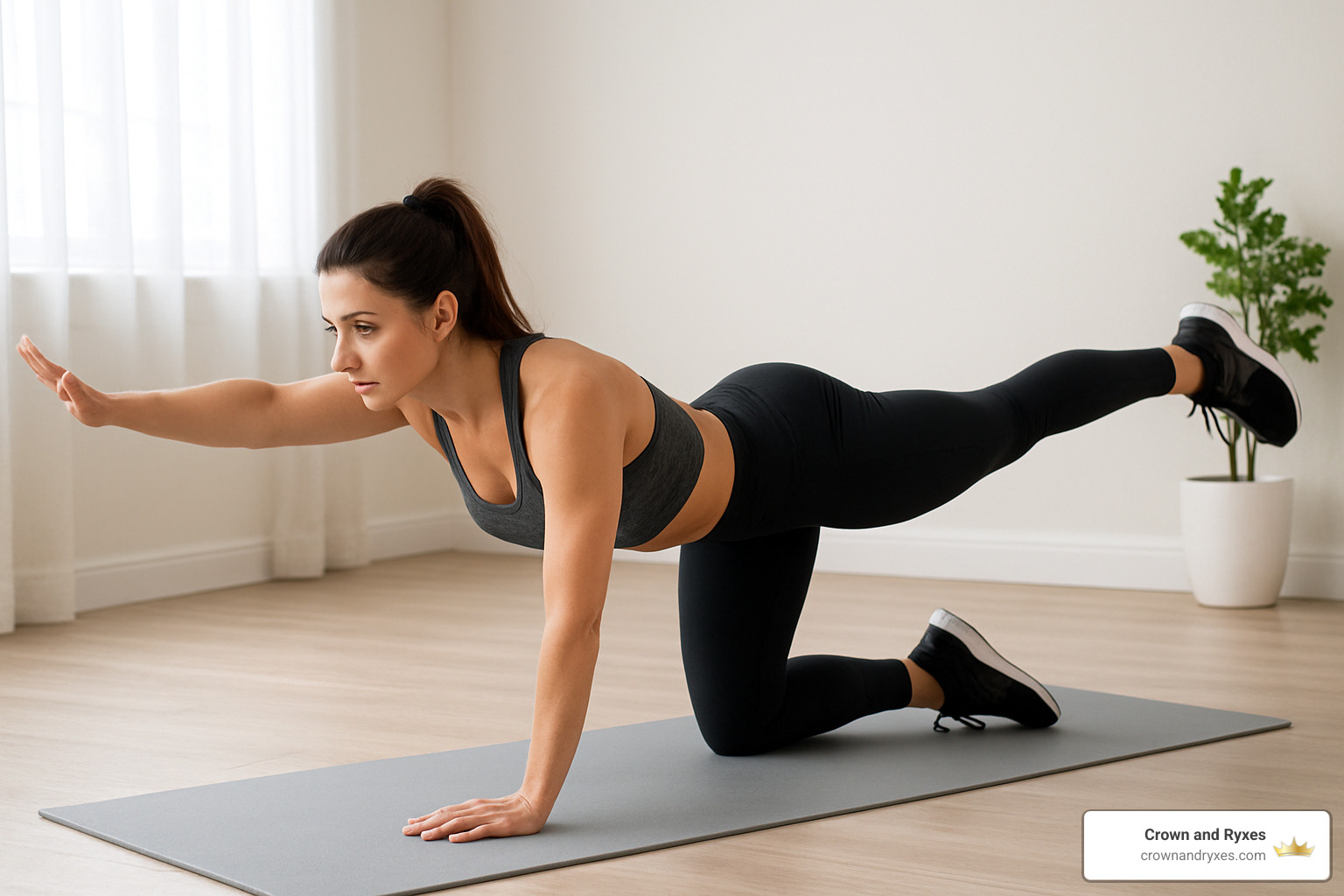
The Bird Dog might look simple, but don’t be fooled – it’s a powerhouse move that creates a full-body stability challenge while engaging your pelvic floor. I love recommending this exercise because it teaches your body to maintain pelvic floor engagement during movement, which is exactly what we need in real life.
How to perform the Bird Dog:
Start on your hands and knees in what we call the tabletop position. Your wrists should be directly under your shoulders, knees under your hips, creating a flat “table” with your back. Take a moment here to find your neutral spine – not arched, not rounded.
Before you move any limbs, engage your pelvic floor muscles women need to activate first. Think of gently lifting those muscles up and in, while drawing your navel slightly toward your spine. This creates your stability foundation.
Take a deep breath in to prepare. As you exhale, extend your right arm forward while simultaneously extending your left leg backward. The goal is to create one long line from your fingertips to your toes. Hold this position for 3-5 seconds while maintaining that pelvic floor engagement.
The real challenge? Keeping your hips level and square to the floor. Your body will want to rotate – resist that urge! This cross-body pattern creates a diagonal line of stability through your core.
Return to your starting position with control, and then repeat with the opposite arm and leg – left arm forward, right leg back. Continue alternating sides for 10-15 total repetitions.
Why the Bird Dog boosts your pelvic power:
The Bird Dog creates what we call a “stability challenge” for your pelvic floor. By removing two points of contact with the ground, you force your core stabilizers – including your pelvic floor – to work harder to maintain balance. This cross-pattern movement also activates the deep connections between your upper and lower body.
When performed regularly, this exercise helps your pelvic floor learn to activate automatically during daily movements like bending, reaching, or climbing stairs. It’s especially beneficial for women returning to exercise after pregnancy or those experiencing mild symptoms of pelvic floor dysfunction.
At Crown and Ryxes, we often incorporate the Bird Dog into our comprehensive women’s wellness programs in Clermont, FL and The Villages, FL. This exercise complements our REGENmax treatments by strengthening the natural support system of the pelvic region, enhancing overall results.
Remember to start slowly with this exercise. If maintaining proper form becomes difficult, take breaks between repetitions rather than compromising your technique. Quality always trumps quantity when it comes to pelvic floor exercises women should practice regularly.
Perfecting Technique & Avoiding Pitfalls
Getting the most from your pelvic floor exercises women need to practice regularly means mastering proper technique. I’ve seen many patients struggle initially because they’re either engaging the wrong muscles or not fully relaxing between contractions – both of which can significantly limit your results.
Think of your pelvic floor training like any other workout – form matters more than repetitions. When you’re first starting out, focus on quality over quantity to build that crucial mind-muscle connection.
One of the most common errors I see is women tensing their buttocks, thighs, or stomach muscles instead of isolating the pelvic floor. While it might feel like you’re doing more work this way, you’re actually bypassing the very muscles you’re trying to strengthen. Similarly, holding your breath during exercises creates additional downward pressure – exactly what we’re trying to counteract with these exercises.
Perhaps the most concerning mistake is bearing down instead of lifting upward. This pushing motion can actually worsen pelvic floor dysfunction over time. The goal is to lift and squeeze inward and upward, like you’re trying to stop the flow of urine or hold in gas.
| Long Contractions | Short Contractions |
|---|---|
| Hold 5-10 seconds | Quick contract-release |
| Builds endurance | Builds quick-response strength |
| Targets slow-twitch fibers | Targets fast-twitch fibers |
| Supports organs consistently | Responds to sudden pressure |
| 10 reps, 3x daily | 10-20 reps, 3x daily |
How To Check You’re Doing It Right
“Am I doing this correctly?” is probably the most common question I hear about pelvic floor exercises women ask during consultations. Since these muscles aren’t visible in a mirror like your biceps, it can be tricky to know if you’re on the right track.
The finger test is one practical way to check your technique. With clean hands, you can insert one or two fingers into your vagina and perform a Kegel. You should feel a gentle tightening and lifting sensation around your fingers. Some women find using a mirror helpful too – when lying down with a mirror positioned between your legs, you should see the area between your vagina and anus lift slightly during a proper contraction.
The most telling sign of correct technique is symptom improvement. With consistent practice, you should notice improvements in symptoms like leakage within 4-6 weeks. If you’re not seeing progress after this time, it might be worth exploring other options.
At Crown and Ryxes, we offer professional biofeedback therapy for women who want more precise guidance. This technology uses sensors to measure your muscle contractions and provides visual feedback on a monitor, helping you perfect your technique. For those in Clermont, FL, or The Villages, FL, our specialists can guide you through this process.
Some women also find vaginal weights or cones helpful. These devices are inserted into the vagina and must be held in place by properly contracted pelvic floor muscles, giving you immediate tactile feedback on whether you’re engaging the right muscles.
Pelvic floor exercises women: Mistakes To Skip
Never push downward during your exercises. This bearing-down motion creates pressure in the wrong direction and can actually worsen problems like prolapse. Think “lift and squeeze” rather than “push and bear down.”
Like any muscle group, your pelvic floor needs recovery time. Overtraining can lead to muscle fatigue and tension, which might create new problems. For most women, three sessions of properly performed exercises daily is plenty.
Always breathe normally during your exercises. I’ve noticed many women instinctively hold their breath while concentrating on contracting their pelvic floor, but this increases pressure on these very muscles we’re trying to strengthen.
While it might seem intuitive to practice by stopping your urine stream, this isn’t recommended as a regular exercise. Doing this once to help identify the correct muscles is fine, but repeatedly starting and stopping urine flow can lead to incomplete emptying and potentially urinary tract infections.
For women with more complex pelvic floor issues, our REGENmax treatments at Crown and Ryxes offer advanced solutions that complement these exercises. There’s no one-size-fits-all approach to pelvic health – what works best is the routine you’ll actually maintain consistently.
Tracking Progress, Tools & When To Seek Help
Seeing results from your pelvic floor exercises women practice requires patience and consistency. Think of it like any fitness journey – progress happens gradually, but the rewards are worth the effort.
Many women find keeping a simple symptom log helpful. Before you begin your training program, jot down how often you experience leakage or discomfort. Then check in every few weeks to note improvements. This tangible record can be incredibly motivating when you start seeing positive changes.
Most women begin noticing subtle improvements after about 4-6 weeks of regular practice. You might first notice you’re leaking less during a sneeze or finding it easier to identify and contract these muscles. More significant changes typically unfold over 2-3 months of consistent work – your body needs time to build strength and create new patterns.
There are several helpful tools that can improve your pelvic floor training journey:
Smart technology can be your ally – several smartphone apps are specifically designed to send friendly reminders for your exercises and track your progress. These digital companions make it easier to build a consistent habit.
One practical technique we teach our clients at Crown and Ryxes is called “The Knack” – consciously engaging your pelvic floor right before activities that increase abdominal pressure, like coughing, sneezing, or lifting. This simple timing adjustment can significantly reduce leakage during daily activities.
For women who want to take their training to the next level, vaginal weights or cones provide progressive resistance training. These work like any other form of strength training – as your muscles adapt, you can gradually increase the challenge.
Special considerations for life stages
Pregnancy is actually an ideal time to practice pelvic floor exercises. These muscles help support your growing baby and prepare your body for delivery. Most women can safely perform these exercises throughout pregnancy, but always check with your healthcare provider first.
The postpartum period requires a gentle approach. Once your healthcare provider gives you the green light (typically at your 6-week checkup), begin with just a few gentle contractions. Even after a C-section, these exercises help restore core function. Start slowly and progressively increase as healing continues.
When professional help makes sense
At Crown and Ryxes, we believe in empowering women with self-care tools, but we also recognize when expert guidance is valuable. Consider reaching out to us or another healthcare provider if:
- You’re unsure if you’re performing the exercises correctly
- You experience pain during the exercises
- You see no improvement after 6-8 weeks of consistent practice
- You have symptoms that concern you (significant leakage, feeling of heaviness, pain)
- You have difficulty identifying or contracting your pelvic floor muscles
For women experiencing more complex pelvic floor issues, especially those affecting sexual function, our REGENmax treatments in Clermont, FL, and The Villages, FL, can complement your exercise program. This innovative approach helps refresh tissue and improve responsiveness when exercises alone aren’t providing the results you desire.
Scientific research on biofeedback therapy consistently shows that professional guidance significantly improves outcomes for women learning these exercises. Sometimes having an expert’s feedback makes all the difference in learning to properly engage these hidden but crucial muscles.
For more comprehensive information about women’s sexual wellness, visit our Female Sexual Health page to explore how pelvic floor health fits into your overall wellbeing.
Frequently Asked Questions about Pelvic Floor Training
How Often Should I Train?
When it comes to pelvic floor exercises women need to practice, finding the right frequency is key. For best results, try to complete your routine three times daily. Each session should include about 10 long holds (where you contract for 5-10 seconds), 10-20 quick flicks, and a few of the functional exercises like bridges or squats.
But here’s the thing – consistency matters more than perfectly hitting those numbers. If three sessions a day feels like too much right now, start with just once daily and build from there. The beauty of these exercises is their discretion – you can do them while sitting at your desk, standing in line at the grocery store, or lying in bed before sleep. No one will even know you’re strengthening your pelvic floor!
“I tell my patients to link their exercises to everyday activities,” says Dr. Casavant at Crown and Ryxes. “Try doing Kegels during your morning coffee, lunch break, and while watching TV in the evening. These habit connections make consistency much easier.”
When Will I Notice Results?
Patience is important with pelvic floor exercises women often wonder about – results don’t happen overnight, but they do come with persistence. Most women begin noticing improvements within 4-6 weeks of consistent practice. These changes might include fewer leaks when you laugh or sneeze, less urgency to rush to the bathroom, improved sensation during intimacy, or better core stability during exercise.
Complete improvement typically takes 3-6 months of regular practice. The good news? About 70% of women with mild to moderate stress incontinence see significant improvement or complete resolution of symptoms when they stick with a dedicated pelvic floor training program. Your body is remarkably responsive to consistent training!
One patient at our Clermont, FL location shared: “After having my second baby, I thought leaking when I jogged was just my new normal. After two months of daily pelvic floor exercises, I can run again without worry. I wish I’d started sooner!”
Are There Risks Or Times To Avoid Kegels?
While pelvic floor exercises women can generally perform safely, there are some situations where caution is needed. These exercises aren’t one-size-fits-all, and sometimes they might not be right for your specific situation.
You should avoid or modify these exercises if:
– You’ve been diagnosed with a hypertonic (too tight) pelvic floor
– You experience pain during the exercises
– You have an active urinary tract infection
Interestingly, some women actually have pelvic floor muscles that are already too tight rather than too weak. In these cases, relaxation techniques may be more appropriate than strengthening exercises. This highlights why personalized guidance can be so valuable.
If you’re unsure whether these exercises are right for you, we recommend consulting with one of our specialists at Crown and Ryxes in Clermont, FL, or The Villages, FL. Our team can provide personalized guidance based on your specific needs and health history. For women experiencing more complex pelvic floor issues affecting sexual wellness, our REGENmax treatments might offer additional support alongside your exercise program.
The goal isn’t just stronger muscles – it’s better quality of life and confidence in your body’s capabilities.
Conclusion & Next Steps
Your pelvic floor deserves your attention—it’s not just about avoiding problems, it’s about embracing your full wellbeing as a woman. By making these five pelvic floor exercises women can easily do part of your daily routine, you’re investing in freedom from worries about leakage, supporting your internal organs, and potentially enhancing your intimate experiences.
Think of pelvic floor training like brushing your teeth—a simple daily habit that prevents bigger problems down the road. The beauty of these exercises is that you can do them almost anywhere: while waiting for coffee to brew, sitting at your desk, or even during your favorite TV show.
Remember what matters most for success:
Make these exercises as routine as your morning coffee—consistency beats intensity every time. Your muscles respond to regular, gentle training better than occasional intense workouts.
Quality trumps quantity—focus on really isolating those pelvic floor muscles and fully relaxing between contractions. That relaxation phase is just as important as the squeeze!
Be patient with your progress—your body will respond in its own time. Most women notice improvements within 4-6 weeks, but complete benefits may take several months to develop.
Look for ways to integrate pelvic floor awareness into everyday movements like lifting groceries or climbing stairs. Using “The Knack” technique—contracting before you cough, sneeze or lift—can make a real difference in daily life.
At Crown and Ryxes, we believe in empowering women with both knowledge and solutions. Sometimes self-care is enough, and sometimes you might benefit from professional guidance. If you’re struggling to feel the right muscles working, not seeing results after consistent practice, or experiencing pain, our specialists in Clermont, FL, and Lady Lake, FL are here to help.
For women experiencing more complex pelvic health concerns, our REGENmax treatments can complement your exercise routine, helping to revitalize tissue and improve responsiveness when exercises alone aren’t quite enough.
Whether you’re a new mom rebuilding strength after childbirth, approaching menopause, or simply being proactive about your health, these exercises are a gift you give yourself. Your future self will thank you for the time you invest now.
Ready to take the next step? Learn more about our women’s sexual wellness services or schedule a consultation to discuss your personal pelvic health goals. Your journey to stronger pelvic health starts today—and we’re here to support you every squeeze of the way.